
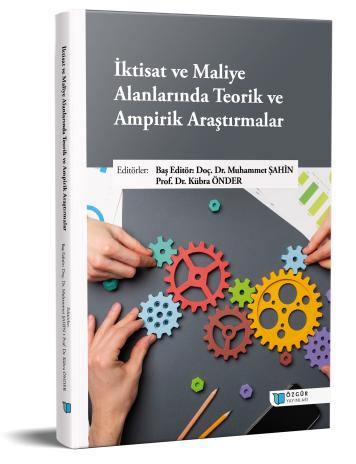
An Analysis of Sectoral Tax Performance and Financial Resilience During Economic Crises: The Case of Turkey
Chapter from the book:
Şahin,
M.
&
Önder,
K.
(eds.)
2026.
Theoretical and Empirical Research in Economics and Public Finance.
Synopsis
Economic crises significantly impact the structure and sustainability of tax revenues by creating macroeconomic instability and uncertainty in national economies. This situation disrupts the balance of public finances, directly affecting the effectiveness of crisis exit strategies and fiscal policies. In developing countries such as Turkey, economic shocks can transform into real crises—particularly through channels such as foreign trade, credit, and confidence—leading to serious deterioration in economic indicators. In this context, global economic crises and debt crises have negatively impacted Turkey’s export-dependent economy, thereby reducing the stability and quality of tax revenues. This situation has been clearly observed during periods such as the 1994, 2000–2001 national crises, the 2008 global crisis, and the 2020 COVID-19 pandemic. During these crisis periods, public expenditures and tax revenues followed a volatile trajectory; in particular, efforts were made to establish fiscal discipline through the “Transition to a Strong Economy Program” implemented following the 2001 crisis. While the 2008 global crisis was mitigated through interest rate cuts and liquidity support, fiscal policy tools such as tax incentives and increased health expenditures played a critical role in reducing the crisis’s impacts during the pandemic. The effects of fiscal rules implemented particularly in the periods following the 2008 global financial crisis and the 2001 domestic crisis on the budget deficit and public debt stock are significant for understanding fiscal performance in crisis management. This study will examine Turkey’s fiscal resilience in detail by evaluating the adaptability of tax policies to crises and the stability of sectoral tax revenues. In this context, tax dynamism analyses reveal the capacity of discretionary tax policy adjustments to influence national income and the sectoral effects of using taxes as a fiscal policy tool beyond their primary revenue-generating purpose.
How to cite this book
License

This work is licensed under a Creative Commons Attribution-NonCommercial 4.0 International License.
Published
DOI
Categories
Copyright (c) 2026 Muhammet Şahin- Kübra Önder; Muhammet Şahin- Kübra Önder- Sevinç Yaraşır Tülümce- Pakize Karabulut- Ceyda Bayraktar Daştan- Yunus Ediz- Seçkin Kabak- Şirin Bülbül- Esin Şenol- H. Muhammet Kekeç