
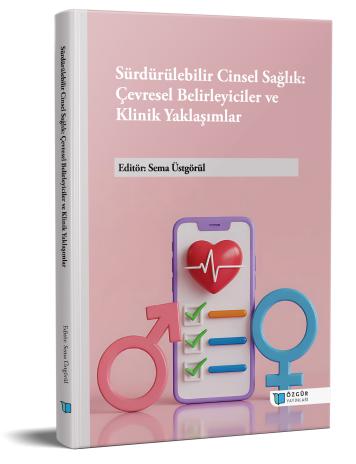
Environmental Determinants of Sexual Health: Endocrine Disruptors, Nutrition and Psychosocial Factors
Chapter from the book:
Üstgörül,
S.
(ed.)
2026.
Sustainable Sexual Health: Environmental Determinants and Clinical Approaches.
Synopsis
Sexual health is a holistic state of well-being shaped by the mutual interaction of biological, environmental, and psychosocial components. This study aims to evaluate the biological foundations of sexual health, the environmental risk factors introduced by modern life, and psychosocial dynamics in light of current literature.
The biological infrastructure of sexual functions is largely regulated by the endocrine system. However, in today’s world, endocrine disrupting chemicals (EDCs) threaten this delicate balance through food, air, water, and consumer products. Exposure to bisphenols, phthalates, and heavy metals particularly during critical developmental windows such as the fetal period and puberty has been found to pose serious risks, including infertility, decreased sperm quality, polycystic ovary syndrome, and reproductive system cancers. Furthermore, the impact of dietary habits on sexual health is a fact that cannot be ignored. While Western-style diets negatively affect reproductive health, it is observed that Mediterranean-type nutrition and foods high in antioxidants support sexual functions and fertility potential.
From a psychosocial perspective, social norms, communication patterns, and stress factors come to the fore. In societies where sexuality is considered a taboo, lack of information and risky sexual behaviors increase, whereas self-efficacy and healthy family communication play a protective role. Consequently, the sustainability of sexual health depends on reducing environmental exposure, adopting healthy lifestyle behaviors, and increasing social awareness. In this process, midwives play a central role in protecting public health by informing individuals about environmental risks and sexual health through their roles as educators, counselors, and advocates.
How to cite this book
License

This work is licensed under a Creative Commons Attribution-NonCommercial 4.0 International License.
Published
DOI
Categories
Copyright (c) 2026 Sema Üstgörül; Sema Üstgörül- İhsan Barış Müldür- Yasemin Yücel- Vasfiye Eroğlu- Sena Cip- Damlagül Acar- Emine Temizkan Sekizler- Seher Öztürk- Burçin Bektaş Pardes- Gülcan Karabulut- Özlem Demirel Bozkurt- Şükran Başgöl- Saadet Karademir