
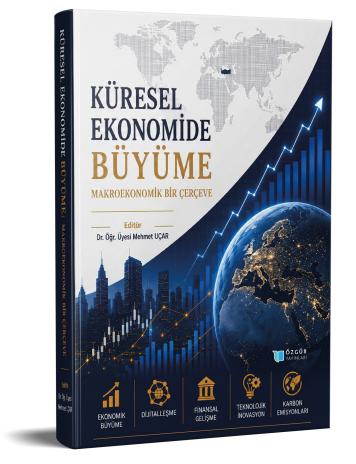
The Impact of Capital Accumulation and Digitalization on Economic Growth in Türkiye: An ARDL Approach (1993–2024)
Chapter from the book:
Uçar,
M.
(ed.)
2026.
Growth in the Global Economy: A Macroeconomic Framework.
Synopsis
This study examines the relationship between economic growth, capital accumulation, and digitalization in Turkey using annual data for the period 1993–2024. Real GDP per capita is used as a proxy for economic growth, gross capital formation represents capital accumulation, and internet usage rate is used as an indicator of digitalization. All variables are transformed into logarithmic form, and time series properties are taken into account in the analysis.
First, the stationarity properties of the series are tested using the Augmented Dickey-Fuller (ADF) unit root test. The results indicate that the variables have different orders of integration. Therefore, the Autoregressive Distributed Lag (ARDL) approach is employed. The bounds test results reveal that there is no long-run cointegration relationship among the variables.
The short-run ARDL results show that capital accumulation has a positive and statistically significant effect on economic growth. However, the coefficient of internet usage is positive but not statistically significant. This finding suggests that the impact of digitalization on economic growth may occur through indirect channels rather than direct effects.
Overall, the results indicate that economic growth in Turkey is largely driven by capital accumulation, while digitalization has not yet become a strong and direct determinant of growth. In this context, strengthening complementary factors such as human capital, technological infrastructure, and institutional quality is essential to enhance the growth effects of digitalization.
How to cite this book
License

This work is licensed under a Creative Commons Attribution-NonCommercial 4.0 International License.
Published
DOI
Categories
Copyright (c) 2026 Mehmet Uçar; Mehmet Uçar- Mücahit Ülger- Mert Anıl Atamer- Ayşe Eryer- Gülferah Ertürkmen- Melek Kıdemli- Lokman Salih Erdem- Kamuran Yıldız- Hüseyin Saltan