
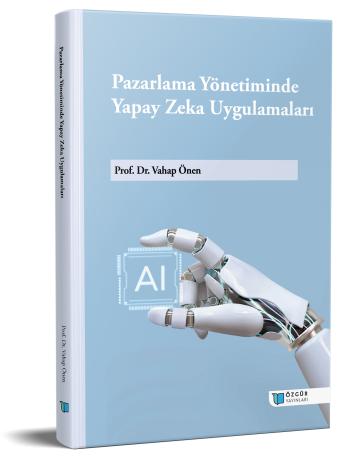
Artificial Intelligence Applications in Marketing Management
Synopsis
Artificial Intelligence has left an impressive mark on the past five years and continues to do so. Technology is advancing so rapidly that in ten years’ time, we may not even be discussing any of what is written here. Applications in the field of artificial intelligence, in particular, are rapidly spreading and penetrating every aspect of life. Given the expectation that new and future generations will be far more capable and proficient in using digital systems, tools, and equipment, it seems highly unlikely that individuals who do not use or benefit from AI will be able to secure managerial positions—or even find a job—in the coming period.
Artificial intelligence has begun to be used in virtually every sector and every aspect of organizations. There are many reasons for this, including economic, social, psychological, technological, and environmental factors. To emphasize a key point: making organizational operations and business processes more efficient and productive, improving the quality of products and/or services, increasing production speed, quickly reflecting product changes in the market, saving on energy and operational costs, reducing labor costs, competition and responding to competitors, better managing customer needs and expectations, and increasing profitability and revenue.
Artificial Intelligence (AI) applications are among the most widely used tools by marketing management units in businesses. Indeed, it seems a new type of application emerges in this field almost daily. There is a growing need for analytical units capable of tracking these applications, analyzing them, selecting the most suitable ones for the business, and phasing out outdated ones. While ChatGPT—an application that revolutionized AI a few years ago and was used by a significant portion of the world—is now used by a much smaller segment of the population. This is because far superior, more reliable, and customizable new products are now available on the market. Today, artificial intelligence applications accompany various types and forms of initiatives across every aspect of Marketing Management: market research, product research, product/service design, distribution-places, pricing, promotions, retention activities, service process management, and all other areas. In particular, the widespread use of the internet, the development of social media, and the fact that the majority of consumers are now active in online environments have led to the growth of digital marketing activities, which have served as a preliminary step for companies transitioning to AI applications. Within the framework of modern marketing management today, digital marketing and its component—artificial intelligence applications—are becoming standard for businesses. Utilizing these applications in marketing management has become an inevitable necessity for businesses to sustain their operations and remain competitive.
For these reasons, this book has been prepared to offer a perspective and provide insights to readers interested in the subject, businesses, and academics working in this field, focusing on specific and limited topics related to AI applications within marketing management. The book contains eleven chapters dedicated to artificial intelligence applications in marketing management. Of course, it should come as no surprise that in the real world, you will encounter far more and a greater variety of such applications than what is described here. With the hope that this work serves as a good starting point for you,
I wish you an enjoyable read.
Chapters
How to cite this book
License

This work is licensed under a Creative Commons Attribution-NonCommercial 4.0 International License.
Published
ISBN
DOI
Statistics
Categories
Copyright (c) 2026 Vahap Önen; Rahşan Pektaş- Ayben Ceyhan Günay- Şahnaz Ekşioğlu- Malik Dündar- Fatma Avan- Halime Büşra Yaşar- Işıl Keskin Şahan- Dilek Yalçın- Cansu Gökmen Köksal- Cemile Küçük- Ebubekir Işık