
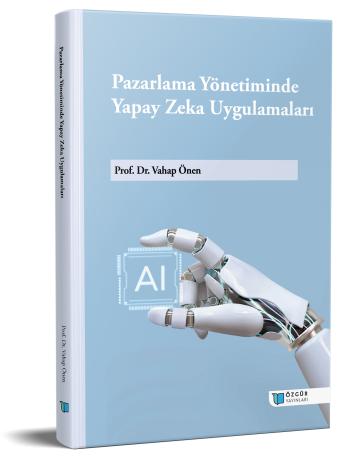
Algorithmic Intuition, Predictive Desire, and the Management of Brand Meaning
Chapter from the book:
Önen,
V.
(ed.)
2026.
Artificial Intelligence Applications in Marketing Management.
Synopsis
This section examines the application of artificial intelligence in marketing management not merely as a realm of technical innovation, but as a multidimensional managerial transformation shaped by decision-making processes, consumer preferences, brand personality, and ethical responsibility. The primary objective of this study is to move beyond a tool-centric approach to the role of artificial intelligence in marketing applications and to reveal the cognitive, organizational, and ethical dynamics underlying these applications.
First, the study discusses how the structure of marketing decisions, which is based on individual intuition, is transforming through the lens of algorithmic intuition and decision intelligence; it argues that artificial intelligence is positioned not as a decision-maker replacing the manager, but as a cognitive partner that redesigns how decisions are generated. Next, within the framework of the concept of “anticipated desire,” the chapter examines how marketing has evolved from a discipline that merely responds to current needs into a strategic structure that anticipates future consumer trends and the contexts in which these trends will emerge.
In the remainder of the chapter, it is discussed that through an AI-supported brand personality approach, brands have transformed from structures that merely describe their identities into actors that exhibit behavior through algorithmic systems. It is emphasized that this transformation fundamentally restructures meaning production in marketing management and the nature of brand–consumer relationships. Finally, by addressing the dimensions of ethics, governance, and algorithmic accountability, it is demonstrated that AI-enabled marketing applications raise not only the question of what is possible but also what ought to be done.
This section adopts an approach that neither unconditionally glorifies AI applications in marketing management nor dismisses them with a reductive critique; it aims to establish a conscious balance between theory and practice. In this regard, the study offers a more responsible, meaningful, and sustainable perspective on the future of artificial intelligence in marketing management for both academic research and managerial practices.
How to cite this book
License

This work is licensed under a Creative Commons Attribution-NonCommercial 4.0 International License.
Published
DOI
Categories
Copyright (c) 2026 Vahap Önen; Rahşan Pektaş- Ayben Ceyhan Günay- Şahnaz Ekşioğlu- Malik Dündar- Fatma Avan- Halime Büşra Yaşar- Işıl Keskin Şahan- Dilek Yalçın- Cansu Gökmen Köksal- Cemile Küçük- Ebubekir Işık