
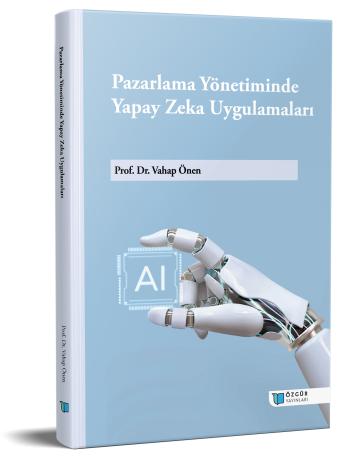
Digital Marketing Automation and the Strategic Role of Chatbots
Chapter from the book:
Önen,
V.
(ed.)
2026.
Artificial Intelligence Applications in Marketing Management.
Synopsis
Digital transformation has been recognized as a fundamental force through which the boundaries of traditional marketing have been reshaped, and the relationships between firms and their customers have been restructured. As a result, the need to comprehensively understand core marketing concepts, to examine the implications of digitalization, and to analyze the integration of automation into marketing processes has been emphasized. Marketing activities are no longer confined to product promotion; rather, they are increasingly characterized by data-driven decision-making processes, customer relationship management practices, and personalized communication strategies. This evolutionary shift from traditional marketing toward digital marketing automation has been observed to provide firms with more efficient, effective, and measurable solutions, while simultaneously enabling the development of sustainable and meaningful customer relationships. Digital marketing automation has been defined as a holistic process through which marketing activities are automated via software-based and technological systems, thereby allowing more effective and personalized customer communication. Through automation systems, customer interactions, campaign execution, segmentation, content distribution, data analysis, and performance measurement are systematically managed, and strategic decision-making processes are supported. Customer behavioral data, interaction histories, and demographic attributes are analyzed, enabling the generation of customized marketing messages for individual users and facilitating more meaningful customer engagement. Moreover, omnichannel communication capabilities are provided through automation systems, allowing integrated strategies to be implemented across email, social media, websites, mobile applications, and chatbots. In this context, customer experience consistency across the digital ecosystem is maintained, while marketing activities are optimized at the channel level. Furthermore, key features of digital marketing automation—such as segmentation and personalization, behavior-based automation, email automation and drip campaigns, lead scoring and lead nurturing, reporting and analytics, CRM integration, content scheduling, and artificial intelligence and machine learning integration—are emphasized as critical components of contemporary marketing strategies. Through these capabilities, higher return on investment, improved customer loyalty, and enhanced marketing performance are achieved. Consequently, digital marketing automation is not merely positioned as an operational efficiency tool, but is increasingly regarded as a strategic infrastructure that supports data-driven marketing, customer-centric value creation, and sustainable competitive advantage within digital ecosystems.
How to cite this book
License

This work is licensed under a Creative Commons Attribution-NonCommercial 4.0 International License.
Published
DOI
Categories
Copyright (c) 2026 Vahap Önen; Rahşan Pektaş- Ayben Ceyhan Günay- Şahnaz Ekşioğlu- Malik Dündar- Fatma Avan- Halime Büşra Yaşar- Işıl Keskin Şahan- Dilek Yalçın- Cansu Gökmen Köksal- Cemile Küçük- Ebubekir Işık