
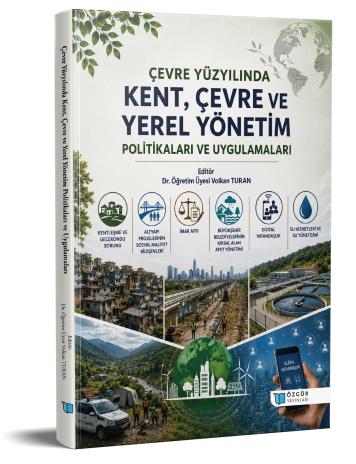
Urban, Environmental and Local Government Policies and Practices in the Century of the Environment
Synopsis
Throughout history, cities have served as centres of economic development, social transformation, and cultural interaction. However, the current “Century of the Environment” has demonstrated that cities are not merely spaces of growth and development; they are also complex living environments that must be evaluated together with natural systems, social structures, and the right of future generations to live. Today, it is no longer possible to plan cities, formulate public policies, or shape local government practices while ignoring environmental concerns. Climate change, ecological degradation, disaster risks, and increasing urbanization pressures necessitate placing the environment at the centre of comprehensive policies.
This book, entitled Urban, Environmental, and Local Government Policies and Practices in the Century of the Environment, has been prepared as an academic work that examines urbanization processes, environmental issues, and the changing roles of local governments through contributions from different disciplines. The book aims to evaluate the relationship between environment and city not only through the lens of physical space but also from social, economic, administrative, and technological perspectives.
One of the most significant consequences of rapid and unplanned urbanization has been the problem of squatter settlements (gecekondu), which have become visible manifestations of spatial inequalities, inadequate infrastructure, and social exclusion in cities. In this context, urban growth dynamics, housing policies, and sustainable urbanization approaches must be reconsidered. Squatter settlements are not merely a construction-related problem; they constitute a multidimensional governance issue in terms of social justice, the right to the city, and quality of life.
Likewise, transportation, energy, water, waste management, and other infrastructure projects represent fundamental investments for urban development. However, they cannot be evaluated solely on the basis of economic benefits. The environmental impacts of these projects, displacement processes, social transformations, and their effects on different social groups must be analysed together with social cost components. A sustainable infrastructure approach encompasses not only technical success but also social acceptance and environmental responsibility.
Another important area of debate within urbanization policies concerns zoning amnesties. Such practices represent a critical issue in terms of planned urbanization, safe construction, and the right to the city. This book discusses, from various perspectives, the impacts of short-term solutions on urban resilience, disaster safety, and environmental sustainability in the long run.
Today, with the expansion of the responsibilities of metropolitan municipalities, disaster management has become an important policy area not only in urban centres but also in rural areas. Strengthening rural regions against climate-related risks, natural disasters, and infrastructure deficiencies is directly associated with the coordination capacity of local governments, early warning systems, and community-based disaster management approaches.
Furthermore, in the age of digital transformation, the relationship between citizens and government has acquired a new dimension. Digital citizenship refers not only to the use of technological tools but also to a new governance approach that strengthens citizens’ participation in decision-making processes, access to information, and interaction with local governments. Smart city applications, digital services, and participatory governance models have become important instruments for achieving environmental sustainability.
In recent years, increasing pressures on water resources, climate change, population growth, urbanization, and environmental problems have made it insufficient to manage water solely as a technical resource. Therefore, transitioning from the traditional understanding of water management to a water governance approach—where public institutions, local governments, the private sector, scientists, and different segments of society participate in decision-making processes—is of great importance. Water governance aims to ensure the more equitable, transparent, participatory, and sustainable use of water resources while balancing the needs of different users. This transformation makes it possible to address water not only within the framework of supply and demand relationships but also through its ecological, social, economic, and administrative dimensions. In this way, an important management model emerges for ensuring water security for future generations and building societies that are more resilient to climate change.
Our book consists of six chapters. In the first chapter, Burak KARAOĞLAN, in his study entitled “Urbanization and the Squatter Housing Problem in Türkiye: Historical Development and State Policies,” examines the concepts of urbanization and squatter housing from a theoretical perspective and analyses them within their political dimensions. He evaluates the historical development of urbanization and squatter settlements in Türkiye and analyses the squatter housing phenomenon within the framework of its causes, consequences, and state policies. Furthermore, he discusses post-2000 urban transformation policies, the practices of the Housing Development Administration of Türkiye (TOKİ), neoliberal urbanization processes, and issues of spatial segregation. The study concludes that the squatter housing problem in Türkiye cannot be reduced merely to unplanned construction; rather, it is directly related to income inequality, neoliberal economic policies, political populism, and inadequate social housing policies.
In the second chapter, Emine BAYDAN, Nisa Nur KÜLAHÇI CEBE, and Esra KESKİN, in their study entitled “An Examination of Social Cost Components According to Project Types in Infrastructure Projects,” investigate the social cost components arising from large-scale infrastructure investments through the differences among project types. Urban rail systems, airports, dam/hydroelectric projects, and power plants are examined as major infrastructure categories representing different spatial scales and externality structures. Social cost components are classified within a three-dimensional analytical framework consisting of impact type, temporal characteristics, and spatial scale. The authors comparatively evaluate the social costs generated by different infrastructure investments. Adopting a conceptual and qualitative approach based on a systematic review of the existing literature, they classify social cost elements thematically and analyse them according to project type. Their findings reveal that social costs vary significantly depending on project type, technical characteristics, and spheres of impact. While social costs in urban rail system projects are largely shaped by accessibility losses and temporary effects associated with construction processes, airports are characterized primarily by land-use changes and permanent noise impacts. In dam and hydroelectric projects, long-term and irreversible effects such as displacement and ecosystem transformation become prominent, whereas emission- and health-related costs are more dominant in power plant projects. Ultimately, the study demonstrates that social cost is not a homogeneous phenomenon and that infrastructure investments should be evaluated in a manner sensitive to project type.
In the third chapter, Ecenur ATAMAN and Şermin ATAK ÇOBANOĞLU, in their study entitled “An Examination of Zoning Amnesty and Zoning Peace in Türkiye within the Context of Policy Documents,” state that the regulation implemented in 2018 under the Provisional Article 16 added to the Zoning Law No. 3194 through Law No. 7143, commonly referred to as the “Zoning Peace” (İmar Barışı), aimed both to register structures that did not comply with existing legal regulations and to establish a form of zoning reconciliation. The authors examine the historical development of zoning amnesty practices in Türkiye and evaluate the place of the 2018 Zoning Peace regulation within this historical process. For this purpose, they analyse legislation related to zoning amnesties, the proceedings of the Grand National Assembly of Türkiye, Development Plans, and reports of Special Expertise Commissions. In addition, they examine reports prepared by professional chambers and newspaper articles concerning the implementation of the Zoning Peace. Within the framework of a historical and descriptive analysis, the study evaluates whether the Zoning Peace shared similar objectives and implementation instruments with zoning amnesties applied in previous periods.
In the fourth chapter, Sevinç YÜCE, in her study entitled “Disaster Management in Rural Areas within the Metropolitan Municipality System: An Evaluation of Local Service Delivery Following Law No. 6360,” argues that local governments’ service delivery and governance capacities have become more important than ever due to accelerating urbanization processes, the impacts of climate change, and the diversification of environmental risks. The study evaluates the capacity of the metropolitan municipality system to provide services related to disaster management and environmental risks in rural areas from the perspective of local government policies. In this context, it first examines the administrative transformation that emerged following Law No. 6360 and the effects of urban-rural integration on local government structures. Subsequently, it analyses the legal and institutional framework of disaster management in Türkiye. Furthermore, the study discusses the role of local governments in disaster risk reduction, emergency response processes, and post-disaster recovery activities within the framework of relevant legislation and policy documents prepared by the Disaster and Emergency Management Presidency (AFAD). It emphasizes the necessity of strengthening the authority, resources, and institutional capacities of local governments in order to create disaster-resilient cities and rural settlements. By addressing the relationship among urbanization, environmental risks, and local government policies from a holistic perspective, the study contributes to the existing literature.
In the fifth chapter, Bülent BAYRAK, in his study entitled “Social Change in the Process of Digital Transformation: Becoming a Digital Citizen,” argues that digital transformation has become a rapidly advancing, widely disseminated, indispensable, and irreversible natural process affecting every aspect of life. He maintains that large segments of society have become architects of a broader social transformation by changing their economic, social, political, and cultural approaches under the influence of digital transformation. The study suggests that individuals’ transition from a real world constructed through letters and words to a virtual world composed of number-based software and digital programs has resulted in digital rules governing individuals rather than individuals governing digital rules, thereby facilitating the digital transformation of society. Through a comprehensive literature review on the concepts of digital transformation, digital society, and digital citizenship in urban and national governance, the author gathers relevant data and offers recommendations aimed at enabling citizens and society to utilize digital transformation practices more effectively and efficiently. The study further demonstrates how digital society applications can be integrated with digital citizenship practices and identifies factors that influence the process of becoming a digital citizen.
In the sixth chapter, Esra ÇİFTCİ METİN and Eylem BEYAZIT, in their study titled “From Water Services to Water Governance: A Risk-Based Transformation in Water Security,” stated that water security, traditionally defined through infrastructure capacity, service continuity, and compliance with quality standards, has become increasingly inadequate for addressing contemporary challenges such as climate change, hydrological variability, water scarcity, and institutional fragmentation. Drawing on the international literature on risk governance, adaptive governance, resilience, precautionary approaches, and anticipatory governance, they argued that risk-based water security approaches function not only as technical safety tools but also as governance instruments. They concluded that water security should be conceptualized not as an infrastructure performance outcome, but as an administrative capability defined by the capacity to anticipate, prioritize, and manage risks under conditions of uncertainty. In doing so, they contributed to the repositioning of risk-based approaches from technical management tools to a comprehensive framework for administrative transformation in water management.
This book evaluates urban, environmental, and local government policies in light of past experiences, contemporary challenges, and future needs. Prepared for academics, students, local government practitioners, and policymakers, this work aspires to contribute to the creation of resilient, inclusive, and sustainable cities that place the environment at the centre of development and governance processes.
I sincerely hope that this book will provide valuable insights for both scholarly discussions and practical policymaking efforts concerning the future of cities, environmental sustainability, and local governance.
Chapters
How to cite this book
License

This work is licensed under a Creative Commons Attribution-NonCommercial 4.0 International License.
Published
ISBN
DOI
Statistics
Categories
Copyright (c) 2026 Volkan Turan; Burak Karaoğlan- Emine Baydan- Nisa Nur Külahçı Cebe- Esra Keskin- Ecenur Ataman- Şermin Atak Çobanoğlu- Sevinç Yüce- Bülent Bayrak- Esra Çiftci Metin- Eylem Beyazıt