
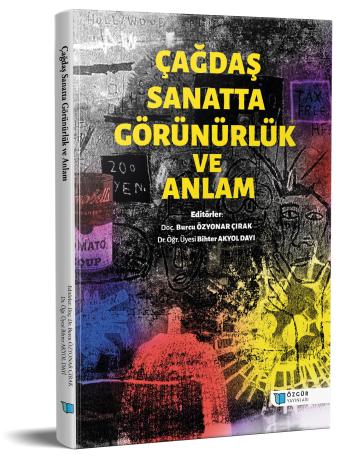
The Relationship Between Violence, Trauma, and Memory in Doris Salcedo’s Artistic Practice: The “Unland” Series
Chapter from the book:
Akyol Dayi,
B.
&
Özyonar Çırak,
B.
(eds.)
2026.
Visibility and Meaning in Contemporary Art.
Synopsis
This study examines the artistic transformation of violence, trauma, and memory through objects in the works of Colombian artist Doris Salcedo. Focusing particularly on the ““Unland”” Series, tables of varying dimensions are perforated and filled with strands of human hair, materializing traumatic histories through the aesthetics of minimalism and conceptualism. Violence is understood as a complex phenomenon affecting the individual across physical, social, and psychological dimensions; trauma as a destructive response that fragments memory; and memory as a process that reconstructs traumatic experience. Salcedo translates the repercussions of the Colombian civil conflict into objects through interviews with victims; for instance, she brings the narratives of orphaned children into the public sphere by means of domestic furniture, thereby exposing intimate forms of destruction. Violence signifies fractured families and loss, while objects bear the traces of trauma, inviting the viewer into an ethical inquiry. The artist conveys violence indirectly through the fragility of materials, evoking empathy and bearing witness. In this way, art multiplies the narratives of victims, prompting confrontation and reactivating memory.Keywords: Violence, Memory, Trauma, Doris Salcedo, Sculpture
How to cite this book
License

This work is licensed under a Creative Commons Attribution-NonCommercial 4.0 International License.
Published
DOI
Categories
Copyright (c) 2026 Bihter Akyol Dayi- Burcu Özyonar Çırak; Bihter Akyol Dayi- Burcu Özyonar Çırak- Buse Kızılırmak Çekinmez- Şükriye İnan Çalapkulu- Eda Seda Tosun- Gülşah Bayraktar- Gülşah Özdemir- Hatice Doğan- Sara Çebi