
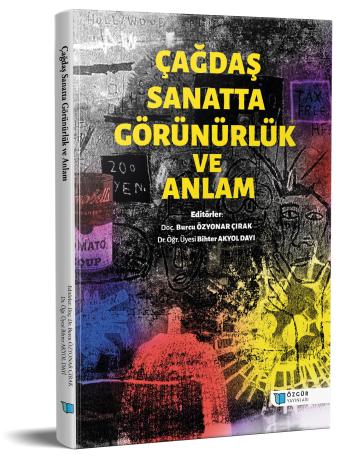
Multi-Religious Practices in Contemporary Art
Chapter from the book:
Akyol Dayi,
B.
&
Özyonar Çırak,
B.
(eds.)
2026.
Visibility and Meaning in Contemporary Art.
Synopsis
The relationship between art and religion dates back to ancient times. The need to make sense of the invisible, to relate to what is considered supernatural, and to represent the sacred have been important sources of artistic production for thousands of years. From ancient frescoes to sculptures, from temple ornamentation to manuscripts, many forms of visual production have been designed to visualize beliefs and represent the sacred. Throughout the Middle Ages, art was used to glorify religion, but with the spread of the Renaissance, it began to include secular subjects alongside religious depictions. In the Baroque period, the aim was to strengthen religious feelings among people, and art was used to create an overwhelming sense of superiority. With the Enlightenment, reason and criticism came to the forefront, and art began to detach itself from religion. In contemporary art, however, the subject of religion has transformed into an experience reflecting the contemporary individual's search for meaning and their questioning of their worldly position. Religion is now seen as a complex field that deals with experiences where the sacred is questioned, the relationship between body and power is revealed, and the viewer is confronted with moral unease. Multi-religious art practices, on the other hand, are applications that use elements such as symbols, images, spaces, writings, and rituals belonging to more than one religion, and that question concepts such as identity, culture, belonging, and sacredness. The aim of this research is to examine which visual arrangements are used to design multi-religious practices in contemporary art. In the works of Gülsün Karamustafa, John Latham, Siona Benjamin, Meg Hitchcock, and Eugenio Merino, cited as examples of multi-religious practices, the way in which images from different religious traditions are brought together has been examined, and it has been concluded that multi-religious practices in contemporary art create a new visual and conceptual relationship among themselves. The works of Gülsün Karamustafa, John Latham, Siona Benjamin, Meg Hitchcock, and Eugenio Merino, presented as examples of multi-religious practices, have been examined to see how images from different religious traditions are combined, and it has been concluded that multi-religious practices in contemporary art create a new visual and conceptual relationship among themselves.
How to cite this book
License

This work is licensed under a Creative Commons Attribution-NonCommercial 4.0 International License.
Published
DOI
Categories
Copyright (c) 2026 Bihter Akyol Dayi- Burcu Özyonar Çırak; Bihter Akyol Dayi- Burcu Özyonar Çırak- Buse Kızılırmak Çekinmez- Şükriye İnan Çalapkulu- Eda Seda Tosun- Gülşah Bayraktar- Gülşah Özdemir- Hatice Doğan- Sara Çebi