
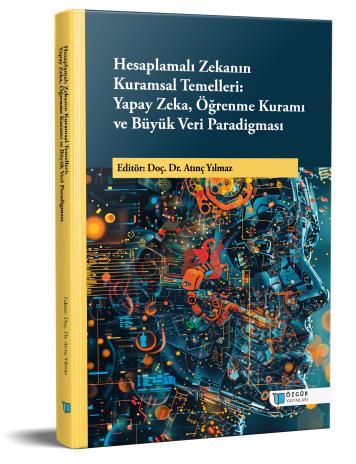
Comparative Analysis of Innovative Thinking and Artificial Intelligence for Systematic Creativity
Chapter from the book:
Yılmaz,
A.
(ed.)
2026.
Theoretical Foundations of Computational Intelligence: Artificial Intelligence, Learning Theory, and the Big Data Paradigm .
Synopsis
In today's competitive environment, businesses struggle to achieve sustainable competitive advantage with traditional approaches that focus solely on reducing costs and increasing operational efficiency. In this context, this study examines innovation from a blue ocean strategy perspective. Innovation is considered a tool that enables businesses to grow through a blue ocean strategy, rather than a red ocean strategy. The study emphasizes the decisive role of innovation in enabling businesses to produce high value-added outputs. Within this framework, a case study is conducted on acquiring innovation skills, applying innovation theory to this purpose. The study demonstrates how innovation skills can be developed through theoretical applications. To better understand the abstract concepts of innovation, a case study using the sand-bicycle metaphor, developed within the framework of the SCAMPER approach, a thinking technique, is employed. Through this metaphor, it is shown that value originates not from physical inputs but from the transformation process achieved through knowledge, technology, and skills. In conclusion, the study suggests that businesses should build their competitive strategies not only on increasing efficiency in existing markets but also on innovation-focused approaches aimed at creating new value areas. In this respect, the study offers a conceptual and theoretical contribution to the innovation literature.
How to cite this book
License

This work is licensed under a Creative Commons Attribution-NonCommercial 4.0 International License.
Published
DOI
Categories
Copyright (c) 2026 Atınç Yılmaz; Sara Naghib Zadeh- Zühre Aydın- Hatice Nur Gök- Cansu Arslan- Uygar Aydın- İnci Zaim Gökbay- Mehmet Dinçer Erbaş- Kenan Peker- Gökhan Önder Ergüven- Tevfik Erdal Baylay- Atınç Yılmaz