
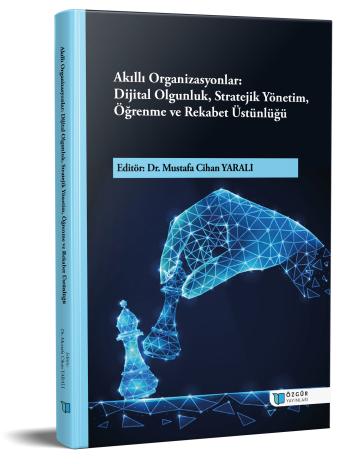
Smart Organizations: Digital Maturity, Strategic Management, Learning, and Competitive Advantage
Synopsis
This book examines the transformation of organizations in the digital age within the framework of fundamental debates in the field of management and organization. Today, organizations are no longer merely structures that use technology; they have transformed into dynamic systems that make sense of data, monitor environmental changes, enhance learning capacity, engage employees in transformation, and strive to make their competitive advantage sustainable. This transformation has made the concept of "smart organization" a significant area of study, both academically and practically.
In this book, smart organizations are not evaluated solely through the lens of digitalization or technological infrastructure. Different dimensions such as digital maturity, strategic management, organizational learning, digital leadership, employee behavior, adaptation, employability, and competitive advantage are considered together. In this respect, the work reveals that digital transformation is more than just a technical process; it is a multi-dimensional change that reshapes organizational culture, human resources, decision-making methods, learning processes, and strategic orientation.
The chapters in the book evaluate the discourse of smart organizations not only from a positive perspective but also with a critical and questioning approach. This book examines topics such as the assumptions and limitations of digital maturity models, the impact of digital skills on employability, cognitive blindness in smart organizations, employee engagement and adaptation in digitized management processes, the historical and functional development of digital transformation, the relationship between organizational learning and sustainable competitive advantage, and digital leadership and employee behavior.
The fundamental premise of this work is that smart organizations stand out not only for possessing technology, but also for how they interpret this technology and integrate it with organizational goals. An organization's ability to be considered smart depends not only on the quality of its digital tools, but also on its learning capacity, strategic adaptability, employee engagement, and organizational response to change. Therefore, the book addresses digitalization with both its opportunities and limitations.
Prepared with contributions from chapter authors working in the fields of management and organization, this book provides a conceptual, theoretical, and critical foundation for the topic of smart organizations. It is expected that this work will contribute to academics, researchers, graduate students, and managers working in the fields of digital transformation, digital maturity, strategic management, organizational learning, digital leadership, and competitive advantage.
Chapters
How to cite this book
License

This work is licensed under a Creative Commons Attribution-NonCommercial 4.0 International License.
Published
ISBN
DOI
Statistics
Categories
Copyright (c) 2026 Mustafa Cihan Yaralı; Gözde Sunman- Mehtap Aracı Kazıcı- Dilek Özdoğan- Tarık Karamolla- Şükran Oruç- Pınar Duygu Akın- Kenan Orçanlı- Semra Köse- Gönül Gül- Gürhan Yanık- Evren Arı