
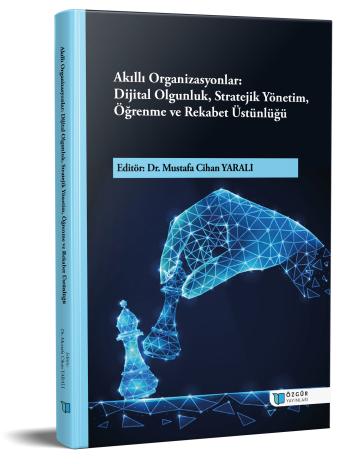
The Digital Transformation Journey of Smart Organizations: Historical Evolution and Functional Transformation
Chapter from the book:
Yaralı,
M.
C.
(ed.)
2026.
Smart Organizations: Digital Maturity, Strategic Management, Learning, and Competitive Advantage.
Synopsis
The digital transformation journey of smart organizations represents a paradigmatic shift from traditional, hierarchical, and control-oriented structures toward agile, knowledge-based, and hyper-connected organizational forms. Built upon the theoretical foundations of the Smart Organization approach and further expanded through Industry 4.0 and AI-driven architectures, this transformation comprehensively addresses the historical evolution and functional restructuring of organizations within the context of the digital economy. This chapter positions smart organizations not merely as entities that utilize technology, but as living knowledge ecosystems capable of continuous learning, developing systemic thinking competencies, and proactively adapting to environmental uncertainties. It examines the historical progression of the concept from R&D-oriented strategic intelligence models to AI-enabled “decision engine” structures that transform data into scalable decisions, emphasizing the role of digitalization in redefining competitive advantage. In addition to its historical framework, the chapter systematically analyzes the impact of digital transformation on core business functions, including management, human resources, production, marketing, accounting, and finance. It highlights the decisive role of technologies such as artificial intelligence, big data analytics, cyber-physical systems, and cloud computing in process redesign, operational optimization, and the enhancement of strategic decision-making mechanisms. In this regard, digitalization is conceptualized not merely as a technical modernization effort, but as a holistic shift in mindset that transforms value creation logic, organizational culture, and governance structures. The chapter integrates theoretical foundations with functional analyses and conceptualizes smart organizations as dynamically responsive and strategically intelligent organizational systems in the digital age.
How to cite this book
License

This work is licensed under a Creative Commons Attribution-NonCommercial 4.0 International License.
Published
DOI
Categories
Copyright (c) 2026 Mustafa Cihan Yaralı; Gözde Sunman- Mehtap Aracı Kazıcı- Dilek Özdoğan- Tarık Karamolla- Şükran Oruç- Pınar Duygu Akın- Kenan Orçanlı- Semra Köse- Gönül Gül- Gürhan Yanık- Evren Arı