
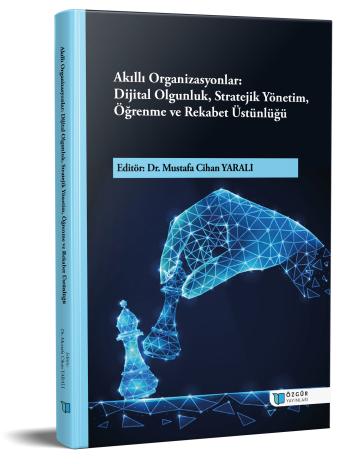
Competitive Advantage in Smart Organizations
Chapter from the book:
Yaralı,
M.
C.
(ed.)
2026.
Smart Organizations: Digital Maturity, Strategic Management, Learning, and Competitive Advantage.
Synopsis
This section examines the concept of intelligent organizations in today’s business environment, where globalization and digitalization have increasingly reshaped competitive conditions. Intelligent organizations represent a strategic organizational model that integrates knowledge management, digital transformation, learning-oriented culture, and organizational agility. Through this integrated structure, they enable businesses to respond more effectively to environmental uncertainty, adapt to changing market expectations, and maintain sustainable success in the long term. In the literature, the strategic significance of intelligent organizations can be explained through various theoretical perspectives, including Porter’s competitive strategies, Barney’s resource-based view, Teece’s dynamic capabilities approach, and Grant’s knowledge-based theory of the firm. These perspectives collectively suggest that competitiveness is no longer based solely on cost advantages or market positioning, but also on the ability to use knowledge, technology, innovation, and organizational capabilities effectively. In this context, intelligent organizations create competitive advantage by making strategic use of technology, encouraging innovation, and strengthening customer orientation. Technologies such as artificial intelligence, big data analytics, automation systems, and digital platforms allow organizations to reduce uncertainty, improve decision-making processes, and respond more rapidly to operational and strategic challenges. At the same time, an innovation-oriented culture supports the development of new products, processes, services, and business models, enabling firms to differentiate themselves from competitors. Customer orientation also plays a central role, as intelligent organizations use data-driven insights to offer more personalized services, improve customer experience, and build long-term customer loyalty. International examples such as Amazon, Google, and Tesla, as well as practices from Türkiye such as Trendyol and developments in the banking sector, show that intelligent organizations are not merely a theoretical concept but a practical model capable of generating sustainable competitive advantage. As a result, intelligent organizations provide businesses with long-term competitiveness through agility, innovation, learning capacity, and knowledge-based decision-making in the modern business world.
How to cite this book
License

This work is licensed under a Creative Commons Attribution-NonCommercial 4.0 International License.
Published
DOI
Categories
Copyright (c) 2026 Mustafa Cihan Yaralı; Gözde Sunman- Mehtap Aracı Kazıcı- Dilek Özdoğan- Tarık Karamolla- Şükran Oruç- Pınar Duygu Akın- Kenan Orçanlı- Semra Köse- Gönül Gül- Gürhan Yanık- Evren Arı