
Public Administration in the Late Ottoman Period: Centralization, Reforms, and Bureaucratic Modernization
Chapter from the book:
Çetin,
M.
Ş.
(ed.)
2026.
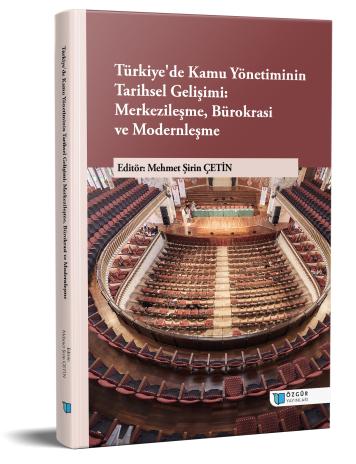
The Historical Development of Public Administration in Turkey: Centralisation, Bureaucracy and Modernisation.
Synopsis
This book chapter examines the profound transformations that took place in Ottoman public administration during its final period, along with centralization policies, reform processes, and bureaucratic modernization efforts, from a historical and analytical perspective. These changes, which gained significant momentum from the early nineteenth century onward, emerged as a fundamental component of the Empire’s struggle to maintain its existence in the face of Western industrial, military, and political superiority. The study systematically addresses the transition from the classical patrimonial model of governance to a modern legal-rational bureaucracy beginning with the reign of Mahmud II, and provides a detailed analysis of the administrative structures, legal regulations, and the role of bureaucratic elites during the Tanzimat, the Reform Edict (Islahat Fermanı), the reign of Abdülhamid II, and the Second Constitutional Era.
During the reign of Mahmud II, the abolition of the Janissary Corps removed the most significant obstacle to central authority; the divan system was abolished and replaced by a ministerial (nezaret) structure, and important steps were taken to establish a professional status for civil servants. The Tanzimat Decree adopted the principle of the rule of law, the 1864 Provincial Regulation established a modern provincial administration, and institutions such as the Mekteb-i Mülkiye were founded to train qualified bureaucratic cadres. While the Reform Edict expanded the principle of equality, it also laid the institutional foundations of administrative and judicial review through the establishment of the Şura-yı Devlet and the Divan-ı Ahkâm-ı Adliye. Under Abdülhamid II, authoritarian centralization reached its peak, and the bureaucracy expanded considerably in both quantitative and functional terms. During the Second Constitutional Era, the debates between centralization and decentralization constituted a fundamental area of tension reflecting the Empire’s structural crises. The chapter critically evaluates the top-down and elitist nature of the reforms, their financial burden and contribution to deepening external indebtedness, as well as the social tensions generated by the duality between traditional and modern institutions. The legacy of Ottoman modernization for Republican Turkish public administration is discussed in the context of the strong centralist state tradition, the pursuit of rational institutionalization, and the legal-rational model of bureaucracy. By presenting the modernization experience of Ottoman public administration within a comprehensive framework, this study aims to contribute to a deeper understanding of the historical origins, continuities, and structural characteristics of contemporary Turkish public administration.
How to cite this book
License

This work is licensed under a Creative Commons Attribution-NonCommercial 4.0 International License.
Published
DOI
Categories
Copyright (c) 2026 Mehmet Şirin Çetin; Yusuf Muyan- Mustafa Fahri Mirhanoğulları- Mehmet Şirin Çetin- Serdar Şenol- Abdurrahman Turgut- Zekerya Çavuş- Selami Özkan- Mustafa Gökberk Ertan