
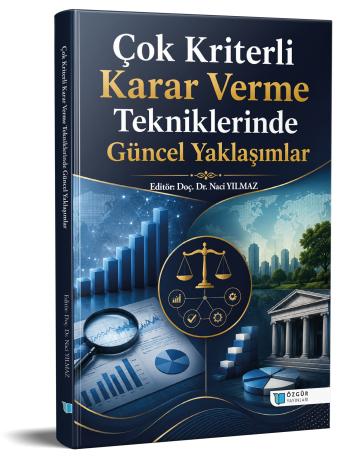
Current Approaches in Multi-Criteria Decision Making Techniques
Synopsis
Decision-making processes are becoming increasingly multidimensional in today's complex economic, financial and social structure. Decision-making styles based on a single indicator, a limited criterion or subjective evaluations; It is often insufficient in areas that require the evaluation of many variables such as regional development, quality of life, financial resilience and banking performance. For this reason, multi-criteria decision-making techniques have become an important methodological tool in terms of bringing together different criteria in the same analytical framework, making alternatives comparable, and providing a systematic structure to decision-making processes. The book in your hand does not only deal with multi-criteria decision-making approaches at the theoretical level; It also reveals the application possibilities of these techniques in different fields with concrete examples. The chapters in the book provide a holistic structure starting from the methodological basis to the quality of life ranking of the provinces in Turkey, the comparison of the financial resilience levels of developing countries and the financial performance evaluation of commercial banks in Romania.
In the first part of the book, Doğan Şengül discusses objective criterion weighting methods in a comprehensive and analytical framework. This section, in which methods such as standard deviation, coefficient of variation, Shannon Entropy, CRITIC, MEREC, LOPCOW, CILOS and IDOCRIW are evaluated in a common structure, forms the theoretical basis of the book on the determination of criterion weights, normalization, information content and method selection. In the second part, Bora Kurtuluş analyzes the quality of life of 81 provinces in Turkey with the Entropy-based TOPSIS approach. The study, which is based on TURKSTAT's 2015 Life in Provinces Index data, provides a data-based view of regional development policies in terms of objectively determining the criterion weights and ranking the provinces according to their distance from positive and negative ideal solutions. In the third part, Hande Eren and Esra Aksoy Erzurumlu compare financial resilience in developing countries with an MCDF-based approach. The study, in which developing economies within the G20 are evaluated using the PSI method on indicators such as financial development, public debt, inflation and banking stability, emphasizes that financial resilience should be considered in a multidimensional framework. In the fourth part, Naci Yılmaz examines the financial performance of commercial banks in Romania in the period 2020-2024 using the hybrid MAXC-based MCRAT method. The study, which evaluates indicators such as liquidity, profitability, efficiency, cost effectiveness, capital adequacy and credit risk together, reveals that banking performance cannot be explained by a single financial ratio.
When the chapters in the book are evaluated together, it is seen that multi-criteria decision-making techniques have a wide range of applications in different disciplines. These techniques are not just mathematical models; are powerful analytical tools that contribute to producing more consistent, transparent and comparable results in economic, financial and social decision processes. I would like to thank all the authors who contributed to this work with their valuable work. For their support in the preparation process for the publication, Dr. Lecturer. I would also like to thank Asst. Prof. Dr. Kürşad ÖZKAYNAR and the employees of Özgür Publications. I hope that the book will be a useful resource for academics, graduate students, researchers, and public and private sector decision-makers working in the field of multi-criteria decision-making techniques.
Chapters
How to cite this book
License

This work is licensed under a Creative Commons Attribution-NonCommercial 4.0 International License.
Published
ISBN
DOI
Statistics
Categories
Copyright (c) 2026 Naci Yılmaz; Doğan Şengül- Bora Kurtuluş- Hande Eren- Esra Aksoy Erzurumlu- Naci Yılmaz