
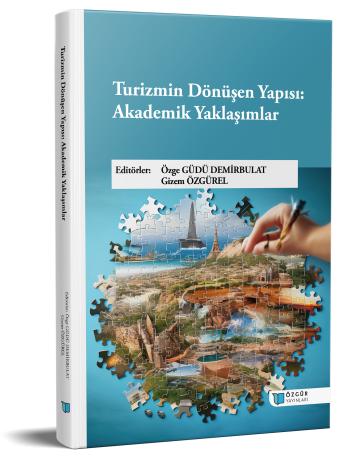
The Changing Structure of Tourism: Academic Approaches
Synopsis
Tourism today is undergoing a multidimensional transformation that can no longer be evaluated solely through economic growth, employment, and destination revenues. The rapid development of digital technologies, changing visitor expectations, deepening sustainability debates, the reinterpretation of cultural heritage, and the construction of consumer perceptions in digital environments all make it necessary to reconsider tourism from both theoretical and practical perspectives. This book examines the transforming nature of tourism through the conceptual possibilities offered by different disciplines and evaluates contemporary topics such as cultural heritage, digitalization, artificial intelligence, brand communication, smart tourism, the sharing economy, regenerative approaches, and gastronomic perception within an academically integrated framework.
The chapters in this book do not limit the changing nature of tourism merely to technological innovation or market dynamics; rather, they open it to discussion through its aesthetic, ethical, social, cultural, and ecological dimensions. The impact of cultural heritage sites on visitors is interpreted through concepts such as mathematical aesthetics, symmetry, proportion, geometric order, and perceptual fluency. In this way, the heritage experience is shown to be associated not only with historical or archaeological values, but also with processes of perception, meaning-making, and memory. This perspective offers an interdisciplinary approach to explaining the touristic appeal of cultural heritage sites.
Another important area of discussion concerning the future of tourism is the limitations of the sustainability approach and the need to move beyond these limitations. In the context of regenerative tourism and doughnut economics, the book examines how destinations can be transformed into more just, balanced, and resilient living spaces within social and ecological boundaries. Accordingly, it emphasizes that tourism success should not be assessed only through indicators such as visitor numbers, revenue, and growth, but also in relation to human well-being, ecological integrity, local quality of life, and the long-term resilience of destinations.
Digitalization constitutes one of the central themes of the book. Artificial intelligence, augmented and virtual reality, social media marketing, influencer marketing, smart tourism technologies, and recommender systems are examined as key factors that are fundamentally transforming tourism marketing, tourist decision-making processes, destination management, and modes of service delivery. AI-supported chatbots, virtual assistants, dynamic pricing, demand forecasting, and personalized recommender systems offer significant opportunities for tourism businesses. However, they also bring risks related to data security, privacy, algorithmic bias, ethical concerns, and employment. For this reason, technological transformation should be addressed not only with a focus on efficiency, but also through human-centred, ethical, and sustainable principles.
Brand communication and digital marketing processes are also evaluated within the transforming structure of tourism. Traditional brand communication tools such as personal selling, direct marketing, sales promotion, public relations, advertising, and sponsorship acquire new meanings in the digitalized tourism environment and reshape the ways in which destinations and tourism businesses communicate with potential tourists. Social media content, electronic word-of-mouth, user-generated content, and influencer effects have become significant factors shaping tourists’ destination perceptions and travel intentions.
The relationship between the sharing economy and cultural heritage tourism is another notable topic addressed in the book. Platforms such as Airbnb, Vrbo, and Couchsurfing provide tourists with opportunities to experience local culture and engage more closely with everyday life practices. At the same time, however, they may also give rise to challenges such as overtourism, cultural commodification, loss of authenticity, security issues, and legal uncertainties. In this respect, the sharing economy is evaluated as a two-sided field that presents both opportunities and risks requiring careful management in the context of cultural heritage tourism.
The influence of digital media platforms in the field of gastronomy is discussed in relation to the dynamics of the post-truth era. Food and beverage establishments, chefs, products, and destinations are often recognized and evaluated through digital content before direct experience takes place. Electronic word-of-mouth, herd behaviour, fear of missing out, influencer-generated content, fake reviews, visual manipulation, and various forms of washing practices may shape consumer perceptions independently of actual experience. In this context, strengthening digital media literacy, transparently labelling AI-generated content, and developing independent monitoring mechanisms emerge as important recommendations.
In conclusion, this book offers a comprehensive academic framework that does not reduce the transforming nature of tourism to a single dimension, but instead evaluates it through cultural, technological, economic, social, ecological, and perceptual perspectives. The chapters bring together theoretical debates on the future of tourism with contemporary fields of practice and provide a multidimensional basis for researchers, sectoral stakeholders, policymakers, and students. In this respect, the book demonstrates that tourism is not merely a sector adapting to changing conditions, but also a dynamic field that produces new values, experiences, relationships, and responsibilities.
Chapters
How to cite this book
License

This work is licensed under a Creative Commons Attribution-NonCommercial 4.0 International License.
Published
ISBN
DOI
Statistics
Categories
Copyright (c) 2026 Özge Güdü Demirbulat- Gizem Özgürel; Ümit Karadağ- Levent Karadağ- Çağnur Çörekli- Setenay Melek Yurttabir- Hasret Ulusoy Mutlu- Muhammed Nurullah Evliyaoğlu- Vildan Tüysüz- Serkan Semint- Serap Ok- Esra Cesur- Özge Alkan