
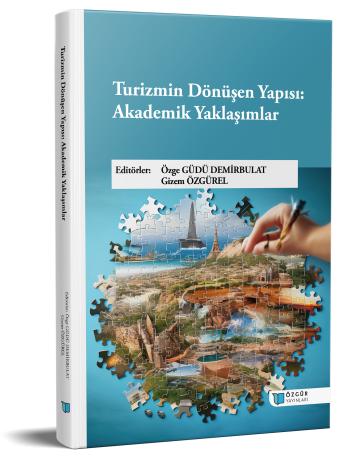
Artificial Intelligence-Driven Transformation in Tourism: Opportunities, Risks, and Future Perspectives
Chapter from the book:
Güdü Demirbulat,
Ö.
&
Özgürel,
G.
(eds.)
2026.
The Changing Structure of Tourism: Academic Approaches.
Synopsis
The tourism industry has been undergoing a continuous process of digital transformation driven by advances in information and communication technologies. In recent years, however, rapid developments in artificial intelligence (AI) technologies have accelerated this transformation and introduced a new stage of change across the sector. The widespread adoption of generative AI applications has significantly altered the ways tourism businesses operate, how tourists access and process information, and how destinations are managed and marketed. This chapter aims to provide a comprehensive examination of AI-driven transformation in tourism, evaluate the opportunities and risks associated with AI applications, and discuss potential future developments within the sector. The chapter first explores the transition from digital transformation to AI-driven transformation and reviews the technological evolution of tourism. It then examines major AI applications used in tourism, including chatbots, virtual assistants, recommendation systems, dynamic pricing tools, demand forecasting systems, and smart destination solutions. Furthermore, the chapter discusses the opportunities offered by AI in enhancing operational efficiency, personalizing tourist experiences, supporting data-driven decision-making, and contributing to sustainable destination management. At the same time, potential challenges such as data privacy concerns, cybersecurity risks, algorithmic bias, employment-related impacts, and ethical issues are critically addressed. The findings suggest that AI should not be viewed merely as a technological innovation but rather as a strategic force shaping the future structure of the tourism industry. Consequently, the successful integration of AI into tourism requires a human-centered, ethically responsible, and sustainability-oriented approach that balances technological advancement with social and managerial considerations.
How to cite this book
License

This work is licensed under a Creative Commons Attribution-NonCommercial 4.0 International License.
Published
DOI
Categories
Copyright (c) 2026 Özge Güdü Demirbulat- Gizem Özgürel; Ümit Karadağ- Levent Karadağ- Çağnur Çörekli- Setenay Melek Yurttabir- Hasret Ulusoy Mutlu- Muhammed Nurullah Evliyaoğlu- Vildan Tüysüz- Serkan Semint- Serap Ok- Esra Cesur- Özge Alkan