
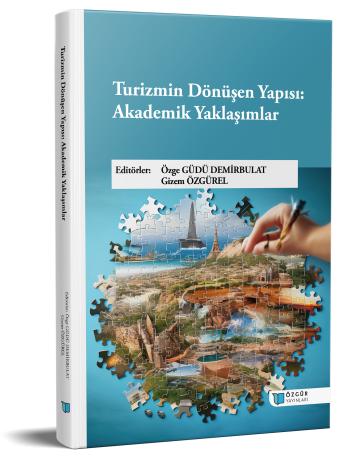
Philosophical Foundations of Mathematical Aesthetics in Cultural Heritage
Chapter from the book:
Güdü Demirbulat,
Ö.
&
Özgürel,
G.
(eds.)
2026.
The Changing Structure of Tourism: Academic Approaches.
Synopsis
The attractiveness of cultural heritage sites is often explained through their historical, archaeological, and symbolic values. However, the question of why visitors perceive certain spaces as more impressive, meaningful, and memorable may not be fully explained by these factors alone. This chapter examines the potential contribution of the concept of mathematical aesthetics to understanding the cultural heritage experience. First, the philosophical foundations of mathematical aesthetics are addressed; the relationship between geometry, harmony, unity, and cosmic order is discussed through Pythagorean thought, Plato’s Timaeus, the concept of geometric proportion, and Platonic solids. Subsequently, the effects of mathematical features such as symmetry, proportion, geometric order, and wholeness on human perception and aesthetic experience are evaluated within the framework of the literature on aesthetic psychology and environmental psychology. The chapter also examines the relationship between geometric order and feelings of aesthetic pleasure, awe, and meaning, and discusses how this relationship may be reflected in the cultural heritage experience. Finally, a conceptual model explaining the connection between mathematical aesthetics and cultural heritage experience is proposed. According to this model, geometric order may strengthen visitors’ feelings of awe, wholeness, and meaning through perceptual fluency and aesthetic pleasure, thereby contributing to the touristic attractiveness of cultural heritage sites. In conclusion, this study offers an interdisciplinary framework suggesting that mathematical aesthetics can be used to explain not only how cultural heritage sites appear, but also how they are perceived, interpreted, and remembered by visitors.
How to cite this book
License

This work is licensed under a Creative Commons Attribution-NonCommercial 4.0 International License.
Published
DOI
Categories
Copyright (c) 2026 Özge Güdü Demirbulat- Gizem Özgürel; Ümit Karadağ- Levent Karadağ- Çağnur Çörekli- Setenay Melek Yurttabir- Hasret Ulusoy Mutlu- Muhammed Nurullah Evliyaoğlu- Vildan Tüysüz- Serkan Semint- Serap Ok- Esra Cesur- Özge Alkan