
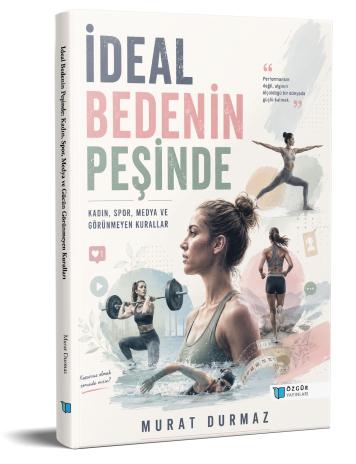
In Pursuit of the Ideal Body: Women, Sports, the Media, and the Unseen Rules of Power
Synopsis
Sports are often thought of solely as a realm of physical performance, competition, discipline, and success. Yet sports are much more than that. Questions such as how the body is perceived, which bodies are considered strong or weak, who has the right to take the field, and who is applauded clearly reveal the social dimension of sports. For this reason, the sports arena is not only a space for games and competitions but also a space for struggles over power, gender, visibility, and representation.
In Pursuit of the Ideal Body was written with the aim of bringing to light women’s historical, social, and cultural struggles in the realm of sports. In this book, the female body is examined not merely as a physical entity, but as a battleground where society, the media, sports institutions, and cultural norms construct meaning. Throughout history, women’s participation in sports has often been restricted by barriers, bans, moral judgments, and gendered assumptions. Yet this history is also one of women’s resistance, persistence, and struggle to carve out a space for themselves.
One of the book’s central questions is: Whose “ideal body” is it? The bodies of female athletes have been evaluated not only by their athletic achievements but also by criteria such as femininity, grace, strength, morality, visibility, and social acceptance. Women have often been expected to perform physically in a way that is both strong and restrained, both successful and modest, both visible and yet not overstepping their boundaries. These conflicting expectations are one of the key factors that distinguish women’s experiences in sports from those of men.
This study examines women’s entry into sports from a historical perspective spanning from Antiquity to the Middle Ages, from the Victorian Era to Turkish sports culture, and to the modern Olympics. It then discusses gender, feminist approaches, heterosexual norms, homophobia, media representation, digital visibility, and the current experiences of female athletes. In this way, the study seeks to understand not only the achievements of female athletes on the field but also the social conditions within which these achievements are produced.
Pierre Bourdieu’s concepts of field, capital, habitus, doxa, and illusio occupy a central place in the book’s theoretical framework. This is because sports are not a neutral field open to everyone on an equal footing. Like any field, sports generate their own rules, hierarchies, forms of acceptance, and mechanisms of exclusion. To establish themselves in this field, female athletes, female administrators, and female media professionals must constantly prove not only their talent but also their legitimacy, knowledge, connections, and visibility.
The media is one of the most visible arenas of this struggle. The achievements of female athletes are often not represented in the same way as those of male athletes; instead, they are evaluated based on their bodies, private lives, emotions, or gender roles. While digital media offers women the opportunity to make their voices heard and gain direct visibility, it has also created new battlegrounds marked by digital violence, harassment, and discriminatory rhetoric. For this reason, visibility represents both a source of strength and, at times, a heavy price to pay for female athletes.
This book does not view women’s presence in sports solely through the lens of success stories. Rather, it seeks to understand the hard work, resilience, exclusion, struggle, and processes of transformation behind these achievements. While it is certainly important for women to be more visible in sports, the real issue is ensuring that this visibility occurs under equal, fair, safe, and respectful conditions.
In Pursuit of the Ideal Body aims to open up a discussion on the unwritten rules in the world of sports, drawing on the experiences of female athletes, administrators, and media professionals. While questioning the male-dominated structure of sports, this book also seeks to demonstrate how women are transforming this structure. For women’s presence in sports is no longer an exception; it is one of the fundamental realities shaping the present and future of sports.
Murat DURMAZ
How to cite this book
License

This work is licensed under a Creative Commons Attribution-NonCommercial 4.0 International License.
Published
ISBN
DOI
Statistics
Categories
Copyright (c) 2026 Murat Durmaz