
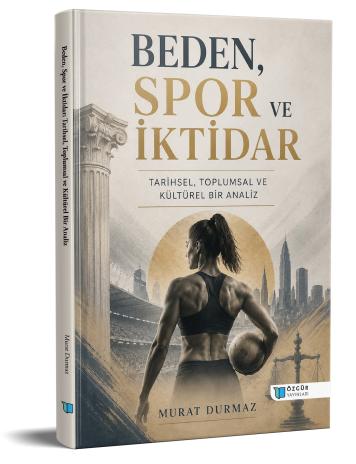
Body, Sports, and Power: A Historical, Social, and Cultural Analysis
Synopsis
The body is the human being’s primary sphere of existence in the world. Humans perceive the world through their bodies, move with their bodies, produce with their bodies, form relationships with their bodies, and find meaning within social life through their bodies. For this reason, the body is not merely a biological structure; it is also a multilayered reality interwoven with historical, social, cultural, political, and economic meanings. How the body is perceived, represented, controlled, and associated with certain values is directly linked to the social structure of the era in question.
This book examines the transformation the body has undergone throughout history from a sociological perspective, within the context of the relationship between sports and power. At times, the body has been viewed as a vital tool for struggling against nature; at other times, as a symbol of aesthetics and power; at still other times, as a bearer of sin and shame; and at yet other times, as a commodity at the center of production and consumption relations. This transformation demonstrates that the body has never belonged solely to the individual; rather, religion, morality, the economy, politics, the media, sports, and consumer culture have constantly intervened in the body.
Throughout history, the meaning of the body has been reshaped according to the needs of social orders. While in primitive societies the body emerged as the fundamental means of survival and production, in antiquity—particularly the male body—was associated with strength, aesthetics, and grandeur. In Christianity and medieval thought, the body was relegated to a secondary position relative to the soul and was framed by concepts of sin, shame, and control. The Renaissance, however, brought the body back into the spotlight, placing it at the center of art, aesthetics, and human-centered thought. With the advent of capitalism, the body became the fundamental object of the production process as a labor force; with the rise of the consumer society, it became the central object of processes of desire, spectacle, and marketing.
In modern society, forms of power over the body have become more complex and invisible. The body is now controlled not only through direct coercion but also through discourses on health, beauty, youth, performance, vitality, and looking fit. While the individual is given the sense of freedom over their body, they are simultaneously taught—on a constant basis—how they should look, what they should eat, how they should exercise, how they should age, and how they should consume. Thus, the body has become one of the most effective areas of intervention for modern power.
In this context, sports and fitness culture also carries a dual meaning. On the one hand, sports are an important activity that supports an individual’s physical and mental health, fosters socialization, and increases resilience and self-confidence. On the other hand, however, sports have also become part of the process of shaping, measuring, displaying, and marketing the body, particularly within a consumer society. Fitness centers emerge as spaces that not only promote the discourse of healthy living but also fuel the desire for an “ideal” body, aesthetic expectations, and consumer habits.
The primary aim of this study is to explore the relationship between the body, sports, and power from historical, social, and cultural perspectives. One of the central premises of this book is to demonstrate that the body is not shaped solely by individual preferences; rather, it is constantly reproduced by class, gender, culture, media, the economy, and power relations. Every discourse constructed around the body also reveals what society considers normal, beautiful, healthy, strong, successful, or acceptable.
For this reason, this book aims to make visible the social meanings underlying seemingly ordinary, everyday practices related to the body. Practices such as exercising, looking fit, trying to stay young, losing weight, building muscle, looking aesthetically pleasing, or living a healthy life are not merely individual choices. These are also reflections of the meanings, expectations, and forms of control that modern society imposes on the body.
Understanding the relationship between the body, sports, and power is of great importance for understanding the relationship that modern humans establish with themselves, their bodies, and society. This is because the body is one of the most visible domains of both individual identity and social order. This book invites readers to rethink the body—to recognize that it is not merely something one possesses, but also a space that is socially constructed, shaped, and controlled.
Murat DURMAZ
How to cite this book
License

This work is licensed under a Creative Commons Attribution-NonCommercial 4.0 International License.
Published
ISBN
DOI
Statistics
Categories
Copyright (c) 2026 Murat Durmaz