
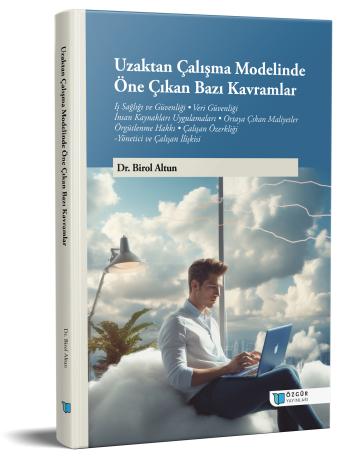
Some Key Concepts in the Remote Working Model
Synopsis
Economies and labor markets around the world are experiencing developments similar to the first industrial revolution that began in the 1700s. The first, second, and third industrial revolutions contributed to the emergence of modern industrial societies in the 20th century. While the transition from agricultural to industrial societies did not occur uniformly across the globe, it did happen. Over time, the agricultural and industrial sectors in economies began to shrink, and service sectors became more widespread. This transformation was not easy. Although it did not follow a continuously progressive path, change continued for approximately 250 years. The fourth industrial revolution marked the beginning of a new phase. The age of technology and information societies began to emerge. The economic crisis of the 1970s led to the emergence of flexible work models in labor markets. Remote work, aided by technological tools, began to take its place in the labor market. This model came to the aid of economies during the challenging conditions of the pandemic, preventing complete economic shutdowns. As with the standard work model, there are certain factors that employees need to consider in the remote work model. In our study, we addressed occupational health and safety, data security, human resources practices, resulting costs, the right to organize, employee autonomy, and the relationship between managers and employees. We examined these issues within the framework of the literature and with data obtained from qualitative studies. We believe that addressing the remote work model, which is expected to maintain its presence in the labor market in the future, from the perspectives we have studied will be beneficial.
How to cite this book
License

This work is licensed under a Creative Commons Attribution-NonCommercial 4.0 International License.
Published
ISBN
DOI
Statistics
Categories
Copyright (c) 2026 Birol Altun