
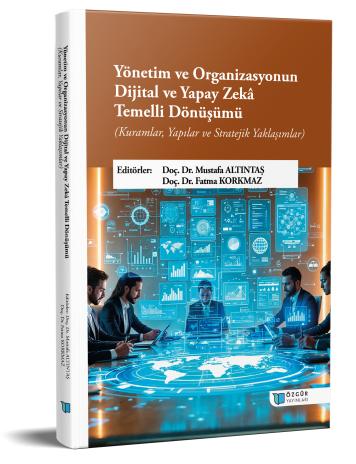
Leadership Approaches in the Digital Age: E-Leadership, Digital Leadership, and Data-Driven Decision Making
Chapter from the book:
Altıntaş,
M.
&
Korkmaz,
F.
(eds.)
2026.
Digital and Artificial Intelligence-Based Transformation of Management and Organization: Theories, Structures, and Strategic Approaches.
Synopsis
Rapid advancements in digitalization and information and communication technologies have brought about a fundamental transformation in organizational structures, ways of working, and leadership philosophies. The inadequacy of traditional leadership theories in organizational environments of the digital age—characterized by uncertainty, complexity, and technological dependence—has made the development of new leadership approaches imperative. As the pace of technological transformation accelerates, it creates new responsibilities and expectations for corporate leaders while highlighting the importance of leadership qualities required by the digital age. The uncertainty, speed, and multidimensional complexity brought by the digital age render traditional leadership concepts inadequate, thereby increasing the importance of new leadership models that integrate technology, strategic management, and people-centered approaches. In this context, digital leadership and e-leadership approaches are coming to the forefront—approaches that can effectively leverage the opportunities offered by digital technologies in alignment with organizational goals, guide organizations through digital transformation processes, maintain communication and coordination in virtual work environments, and simultaneously support cultural transformation from a human-centered perspective.
This chapter aims to comprehensively examine the prominent leadership approaches of the digital age—namely e-leadership, virtual leadership, and digital leadership—and systematically reveal the key similarities and differences among these approaches. The chapter first addresses e-leadership within the framework of the "Six-Component Model" developed by Van Wart et al. (2019). Subsequently, traditional leadership and e-leadership are compared based on criteria such as the concept of leadership, interaction environment, communication style, source of power, decision-making process, and the role of technology. The concept of digital leadership is introduced, and its relationship with e-leadership is analyzed. In this context, it is emphasized that while e-leadership refers to a specific form of communication and collaboration, digital leadership entails the transformation of an entire organizational culture. Furthermore, the use of digital leadership as an "umbrella term" encompassing e-leadership, virtual leadership, technology leadership, and Leadership 4.0 is evaluated. Finally, data-driven decision-making (DDDM), which plays a decisive role in the effectiveness of digital leadership approaches, is examined in terms of its differences from traditional decision-making models.
How to cite this book
License

This work is licensed under a Creative Commons Attribution-NonCommercial 4.0 International License.
Published
DOI
Categories
Copyright (c) 2026 Mustafa Altıntaş- Fatma Korkmaz; Abdulsamet Duran- Burcu Atar- Musa Özata- Aslı Öztürk- Uğur Dagtekin- Ahmet Kâmil Kabakuş- Zümral Gültekin- Kevser Küçük Can- Mustafa Atsan- Mehmet Ertem- Erol Tekin- Benazir Öztürk