
Digitalization in Strategic Management: Artificial Intelligence, Competitive Advantage, and Dynamic Capabilities
Chapter from the book:
Altıntaş,
M.
&
Korkmaz,
F.
(eds.)
2026.
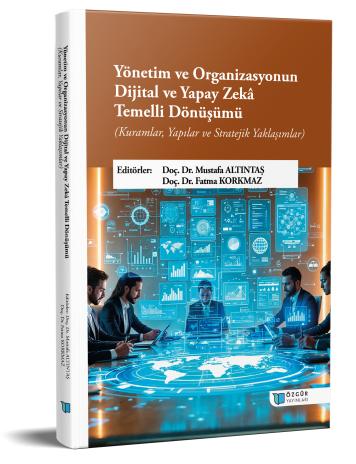
Digital and Artificial Intelligence-Based Transformation of Management and Organization: Theories, Structures, and Strategic Approaches.
Synopsis
This chapter examines the impact of digitalization and artificial intelligence on strategic management from a dynamic capabilities perspective. Digital transformation is addressed as a strategic process that reshapes value creation and competitive logic rather than merely a technological change. In this context, artificial intelligence is considered not only as an operational tool but also as a strategic capability that transforms decision-making processes and enables competitive advantage.
The study integrates the resource-based view and dynamic capabilities theory to explain the role of new strategic resources such as data, algorithms, and digital platforms. It is emphasized that these resources alone are insufficient and that value emerges through their integration into organizational processes. Accordingly, a conceptual model is proposed to explain the role of AI in sensing, seizing, and transforming processes.
The model demonstrates that AI enhances firms’ ability to respond to environmental changes through data analytics, decision support systems, and automation. It also shows that competitive advantage has shifted from a static to a continuously renewed dynamic structure. Practical implications of the model are discussed through example applications, highlighting the importance of organizational alignment and data-driven approaches.
In conclusion, the study provides an integrated conceptual framework linking artificial intelligence, dynamic capabilities, and competitive advantage.
How to cite this book
License

This work is licensed under a Creative Commons Attribution-NonCommercial 4.0 International License.
Published
DOI
Categories
Copyright (c) 2026 Mustafa Altıntaş- Fatma Korkmaz; Abdulsamet Duran- Burcu Atar- Musa Özata- Aslı Öztürk- Uğur Dagtekin- Ahmet Kâmil Kabakuş- Zümral Gültekin- Kevser Küçük Can- Mustafa Atsan- Mehmet Ertem- Erol Tekin- Benazir Öztürk