
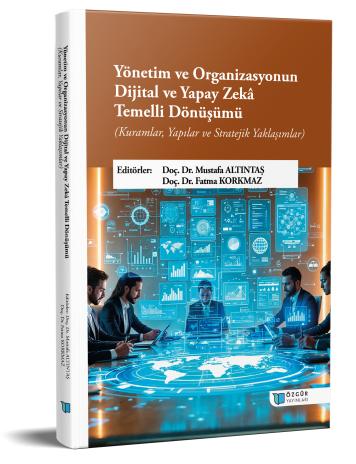
Organizational Resilience and Crisis Management: Digital and AI-Powered Approaches in the Context of Uncertainty
Chapter from the book:
Altıntaş,
M.
&
Korkmaz,
F.
(eds.)
2026.
Digital and Artificial Intelligence-Based Transformation of Management and Organization: Theories, Structures, and Strategic Approaches.
Synopsis
This book chapter aims to reframe the ontological relationship between organizational resilience and crisis management within the axis of digitalization and artificial intelligence technologies in the era of polycrisis and VUCA. The static structure of traditional crisis management, which focuses on bouncing back to the old normal, remains inadequate in today's radical and dynamic environments of uncertainty. Accordingly, this study places the vision of bouncing forward at the center by treating crises not merely as external shocks to be overcome, but as evolutionary turning points that trigger the structural transformation of organizations. Cognitive overload and decision blindness faced by leaders during crises render classical risk management mechanisms dysfunctional. The study proposes a human-AI symbiosis as a theoretical model that brings together the data processing speed provided by AI-powered decision mechanisms and predictive analytics with human contextual awareness, ethical reasoning, and intuitive power. Examining the pre-crisis, peri-crisis, and post-crisis periods through a comprehensive hybrid resilience model with a spatio-temporal approach, the chapter blends the role of artificial intelligence in operational processes with the restorative function of leadership on relational systems. In conclusion, it is emphasized that technology alone is not a savior, and a hybrid management architecture supported by dynamic capabilities and double-loop learning is of critical importance in building sustainable techno-resilience.
How to cite this book
License

This work is licensed under a Creative Commons Attribution-NonCommercial 4.0 International License.
Published
DOI
Categories
Copyright (c) 2026 Mustafa Altıntaş- Fatma Korkmaz; Abdulsamet Duran- Burcu Atar- Musa Özata- Aslı Öztürk- Uğur Dagtekin- Ahmet Kâmil Kabakuş- Zümral Gültekin- Kevser Küçük Can- Mustafa Atsan- Mehmet Ertem- Erol Tekin- Benazir Öztürk