
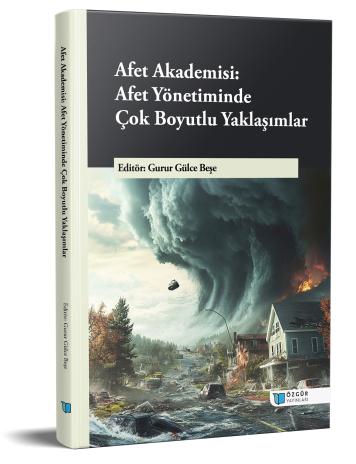
Layered Vulnerability in Disasters: The Intersection of Migration, Poverty, and Trauma
Chapter from the book:
Beşe,
G.
G.
(ed.)
2026.
Disaster Academy: Multidimensional Approaches to Disaster Management.
Synopsis
This study examines the vulnerability of migrants in disasters through the framework of the layered vulnerability approach, focusing on the intersection of migration, poverty, and trauma. The primary aim is to demonstrate that disasters are not merely events causing physical destruction but also structural processes that exacerbate existing social inequalities. Employing a qualitative research design, the study utilizes document analysis as its primary data collection technique. Drawing on the theoretical perspectives of social vulnerability and intersectionality, it analyzes migrants' experiences during disasters in terms of legal status uncertainty, economic insecurity, limited access to social support networks, and prior traumatic experiences. The findings indicate that migrants are exposed not only to physical hazards during disasters but also to structural inequalities, exclusionary mechanisms, and barriers to accessing essential services and assistance. The analysis further reveals that the psychosocial impacts of migration and disaster experiences reinforce one another, often resulting in a phenomenon described as double trauma. In addition, the study highlights that citizenship-based disaster assistance mechanisms and the limited representation of migrants in the media contribute significantly to increased post-disaster vulnerability. These findings underscore the need for inclusive disaster risk reduction and response policies that address the multidimensional vulnerabilities of migrant populations.
How to cite this book
License

This work is licensed under a Creative Commons Attribution-NonCommercial 4.0 International License.
Published
DOI
Categories
Copyright (c) 2026 Gurur Gülce Beşe; Fırat Semih Avşar- Mahmut Said Çam- Ümit Topcuoğlu- Gurur Gülce Beşe- Şerafettin Okan Yayla- Tuba Işık- Serinay Altundağ- Yiğit Aydın Şahin- Şeyma Tosun- Yasin Hasgül- Arzu Güneş- Çilem Bakar Aynacı