
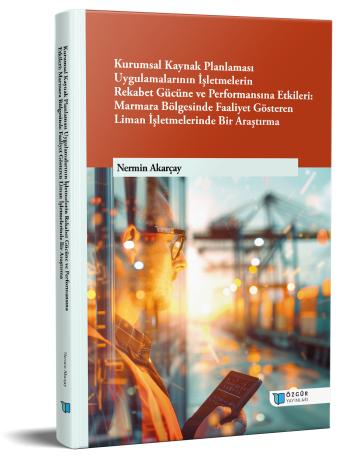
The Effects of Enterprise Resource Planning Applications on the Competitiveness and Performance of Businesses: A Study in Port Operators Operating in the Marmara Region
Synopsis
Enterprise Resource Planning systems are difficult to implement but equally useful for businesses. In this system, the information of all the departments of the company is in the same database and these departments, which have very different needs and outputs, use the same computer program. ERP systems are normally complex programs, but can be regulated for businesses. They must be prepared very carefully and meticulously in the implementation phase and fully respond to the business needs. In some cases, even if ERP software is installed very successfully, it may not be able to deliver the desired results, that is, it may not maximize the firm benefit. For this reason, businesses must increase their competitiveness.
Competition is a dynamically functioning process in the market economy. Due to this feature, it is seen that the rules that affect the field of competition are in a constant change. The industry in question needs to be strengthened in terms of competition by competing in the international market. Thus, it will be able to demonstrate the competitive power of the country in which the industry operates. Enterprises with high competitiveness also have high performance.
Business performance is a systematic process consisting of an organization's input, transformation, output and finally feedback. In general, operating performance is the resulting output or results of operating activities that have been carried out at certain periods. Measuring the performance of the company is important in terms of controlling the activities it displays, on the one hand, and gaining the satisfaction of the customers in the targeted market, on the other. Data on performance measurement results have an important effect on the decisions taken by managers for business performance measurement.
As a result of the analysis; Improving business processes, which are sub-dimensions of Enterprise Resource Planning, are among the sustainable competition dimensions; cost leadership, strategic instability and focus affect competitive advantage. It affects the dimensions of competition, flexibility, resource utilization and innovation among the performance dimensions;. Business processes need to be improved in order to manage the processes well in the period when the customers' expectations and demands change rapidly. Process improvement studies are carried out to reduce cycle times with certain methods in which the organizational structures and business processes of port enterprises will be applied. Also, if there are flexible and innovative works, these can be done faster and easier.
Reliability of financial analysis, which is the sub-dimension of Enterprise Resource Planning, and strengthening communication, are among the sustainable competitive advantage dimensions; differentiation affects competitive advantage and cost leadership. In the business environment, which has a changing and dynamic structure, port enterprises aim to achieve a competitive advantage in order to ensure the reliability of their financial analysis. Financial reliability affects the delivery of different products and services by reducing the costs of businesses and businesses strive to be strong in global competition. In addition, keeping the communication of the companies strong in all other internal and external relations, especially in their own units, enables them to see, evaluate and take measures.
How to cite this book
License

This work is licensed under a Creative Commons Attribution-NonCommercial 4.0 International License.
Published
ISBN
DOI
Statistics
Categories
Copyright (c) 2026 Nermin Akarçay