
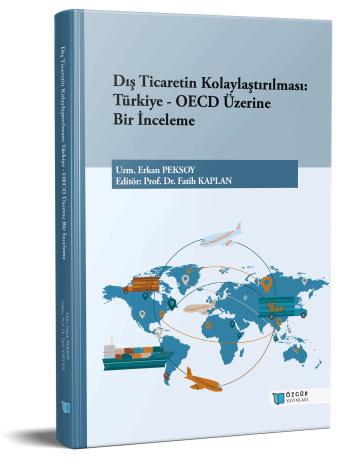
Facilitation of Foreign Trade: An Analysis on Türkiye and the OECD
Synopsis
International trade is a complex and challenging process due to its impact on individuals and institutions from different geographies. International organizations and institutions such as the World Trade Organization (WTO), the World Customs Organization (WCO), and the United Nations (UN) contribute to the facilitation of foreign trade through regulatory frameworks, technological infrastructure improvements, joint transport programs, and efforts on guarantees and assurances. The purpose of this book is to examine Turkey’s position among OECD countries regarding trade facilitation using the Data Envelopment Analysis (DEA) method. For this purpose, two output variables were determined: the Customs Procedures Performance Index and the Ease of Doing Business Index. Four input variables were also selected: GDP, Foreign Direct Investment (net inflows), Trade Openness, and Political Stability and Absence of Violence/Terrorism. In this study, both the CCR model developed by Charnes, Cooper, and Rhodes (CCR) and the BCC model developed by Banker, Charnes, and Cooper (BCC) were applied together. Israel, South Korea, Luxembourg, and New Zealand served as reference countries for Turkey. The analysis results suggest that Turkey could achieve an efficient structure if it implements reforms in the fields of Customs Procedures Performance and Ease of Doing Business.
Keywords:
How to cite this book
License

This work is licensed under a Creative Commons Attribution-NonCommercial 4.0 International License.
Published
ISBN
DOI
Statistics
Copyright (c) 2025 Erkan Peksoy; Fatih Kaplan