
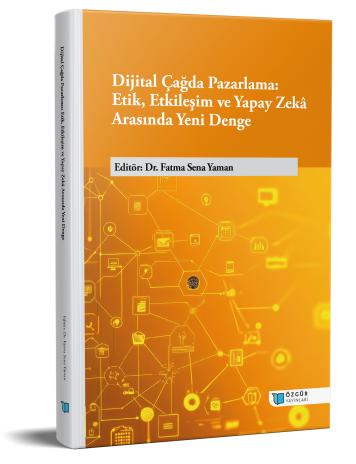
Marketing in the Digital Age: A New Balance Between Ethics, Engagement, and Artificial Intelligence
Synopsis
Global environmental crises, the rapid advancement of digital technologies, and evolving dynamics of social transformation have reshaped the discipline of marketing — transforming it from a purely sales-oriented field into one grounded in ethics, sustainability, and digital responsibility. In this new era, where consumption habits, communication practices, and the relationship between businesses and audiences have been fundamentally altered, organizations are no longer merely sellers of products but producers of meaning, builders of value, and active participants in social transformation.
This book adopts a holistic approach to contemporary marketing communication, offering a multidimensional examination of how technological innovations, social media culture, and artificial intelligence have redefined individual–brand interactions. Built upon academic foundations yet enriched with practical insights, it expands the discussion from ethical marketing to green communication, and from digital ethics to emotional sustainability. Going beyond traditional marketing perspectives, it explores the foundations of a “responsible communication era,” providing readers with both theoretical depth and practical guidance.
In her chapter “Sustainability-Oriented Integrated Marketing Communication,” Fatma Sena Yaman discusses how brands redefine their environmental and social responsibilities as communicative values within the intersection of sustainability principles and marketing communication. The author emphasizes that integrated marketing communication has evolved from a promotional tool into an ethical, transparent, and socially responsible management approach. By integrating concepts such as green marketing, ethical consumption, and corporate social responsibility, Yaman examines the new dimensions that digitalization and social media have introduced into sustainable communication strategies. Viewing greenwashing as a threat to brand credibility, she argues that long-term reputation can only be achieved through transparency, accountability, and consistency.
In “Ethics, Sustainability, and Environmental Responsibility in Digital Marketing,” Öznur Aktaş encourages a rethinking of marketing’s ethical, environmental, and social dimensions in light of digital transformation. The author addresses issues such as privacy violations, manipulative interface design, and carbon footprint in data-driven marketing strategies, while also discussing the opportunities that artificial intelligence, big data, IoT, and blockchain technologies offer for sustainability. The chapter asserts that digital marketing must balance economic efficiency with social trust and environmental ethics. Aktaş highlights that a digital ethics framework supported by green technologies will be the key determinant of future competitiveness.
In “Social Media Marketing from the Perspective of Parasocial Interaction,” Mehmet Gökerik evaluates the communicative transformation of the digital age through emotional and psychological lenses. Demonstrating how social media and participatory culture have redefined the relationship between individuals and brands, he interprets the phenomenon of influencer trust, belonging, and identification through Horton and Wohl’s parasocial interaction theory. Gökerik argues that these one-sided yet emotionally authentic interactions deeply influence consumer behavior and brand loyalty, offering an original contribution that invites a rethinking of trust, sincerity, and emotional sustainability in digital marketing.
In “Digital Intelligence, Social Impact: The New Frontiers of AI-Driven Marketing,” Ebubekir Işık provides an in-depth exploration of the strategic, ethical, and social transformation brought by artificial intelligence to the marketing domain. He explains how personalization, data analytics, and targeting processes reshape consumer engagement, emphasizing the growing importance of trust, loyalty, and transparency in this new paradigm. Evaluating the rise of AI-generated content and virtual influencers through an ethical lens, Işık underscores that technological innovation can create sustainable value only when combined with ethical responsibility. The chapter positions the future of marketing within a new balance between digital intelligence and human influence, offering a visionary contribution to the field.
In conclusion, this book not only contributes to the discipline of marketing but also to the broader pursuit of ethics and social responsibility in the digital age. Each chapter offers a unique perspective that reinterprets the language of contemporary communication, proposing new pathways for future brands to be not just visible, but meaningful and responsible.
Chapters
How to cite this book
License

This work is licensed under a Creative Commons Attribution-NonCommercial 4.0 International License.
Published
ISBN
DOI
Statistics
Categories
Copyright (c) 2025 Fatma Sena Yaman; Fatma Sena Yaman- Öznur Aktaş- Mehmet Gökerik- Ebubekir Işık