
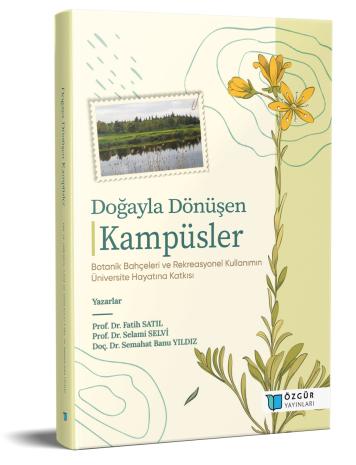
Nature-Integrated Campuses: The Contribution of Botanical Gardens and Recreational Use to University Life
Synopsis
This book discusses how botanical gardens can be regarded not only as centers for scientific research and education but also as recreational spaces where individuals can reconnect with nature and experience mental and spiritual renewal, supported by examples and explanations. The study explores the social, psychological, and physical effects of botanical gardens located within university campuses, in addition to their educational, research, and conservation functions. Based on the case of Balıkesir University (BAUN), the research provides a comprehensive evaluation of nature-based solutions, the contribution of green spaces to learning environments, and the tourism/cultural roles of botanical gardens. It also includes information about the general characteristics and natural vegetation of the BAUN Botanical Garden. Furthermore, the book presents detailed descriptions of the morphological, ecological, and medicinal properties of ten medicinal and aromatic plants cultivated in the BAUN Botanical Garden. Highlighting the importance of these spaces, which bring beauty, tranquility, and inspiration to university life, this work serves as a valuable guide for academics and administrators aiming to build environmentally and student-friendly campuses. This publication was produced within the scope of the Balıkesir University BAP Project No. 2023/048.
How to cite this book
License

This work is licensed under a Creative Commons Attribution-NonCommercial 4.0 International License.
Published
ISBN
DOI
Statistics
Categories
Copyright (c) 2025 Fatih Satıl- Selami Selvi- Semahat Banu Yıldız