
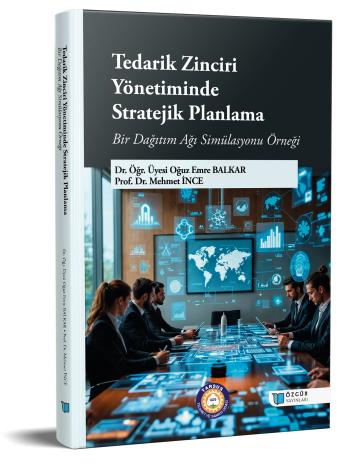
Strategic Planning in Supply Chain Management: An Example of a Distribution Network Simulation
Synopsis
This study aims to provide a comprehensive theoretical framework in the field of logistics and supply chain management and to offer recommendations to relevant parties based on the results of scenario-based distribution network simulations addressing a specific problem. The research first explores the concepts of supply chain, logistics, strategic planning, performance management, and network design in detail.
Then, in the case study section, a food company's existing distribution network in Türkiye, including its production facility in Kahramanmaraş and the warehouses it serves in Erzincan and Uşak, was examined. A total of six different scenarios were developed to evaluate three potential warehouse locations in Denizli, Sivas, and Eskişehir that the company could use. A mixed integer linear programming mathematical model was constructed based on data obtained from the relevant company. Within the scope of this model, scenario-based what-if simulation experiments were conducted using a discrete event approach in anyLogistix PLE (v.3.3.2) software for a one-year planning period spanning January 1, 2026, and January 1, 2027. The scenarios were comparatively evaluated based on criteria such as demand fulfillment rate, total transportation cost, other expenses, total cost, revenue, and profitability.
The findings reveal that the scenario that best balances cost, service level, and profitability is the sixth, which combines Eskişehir and Sivas. The study is believed to contribute to the idea that scenario-based simulation experiments provide decision-makers with more effective insights than traditional static methods in distribution network design.
How to cite this book
License

This work is licensed under a Creative Commons Attribution-NonCommercial 4.0 International License.
Published
ISBN
DOI
Statistics
Categories
Copyright (c) 2025 Oğuz Emre Balkar- Mehmet İnce