
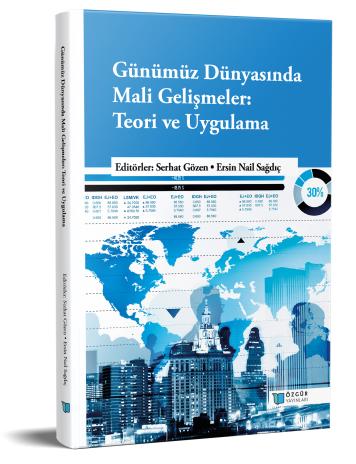
Fiscal Developments in the Contemporary World: Theory and Practice
Synopsis
The global economy is undergoing a radical transformation process under the influence of multidimensional shocks such as pandemics, geopolitical tensions, climate crisis, and technological transformations. In this process, the role of the state in the economy, the efficiency of public expenditures, the fairness dimension of tax policies, fiscal transparency, and environmental sustainability have become among the most important discussion topics in economics and public finance literature. This book, titled "Financial Developments in the Contemporary World: Theory and Practice," aims to provide both a theoretical framework for these discussions and to shed light on them with empirical evidence through examples from Turkey and the world. The thirteen chapters in the book examine financial events not only as economic data but also with their social, legal, environmental, and structural dimensions. In this context, summaries of the chapters included in the book are given below.
In the first chapter, Göksel Karaş empirically examined the role of monetary and fiscal policies in controlling inflation in the Turkish economy with data covering the period 2006Q1-2025Q2. The analysis revealed that both policies are decisive on inflation, but the direction of the effect changes according to macroeconomic conditions.
In the second chapter, Hasan Hüseyin Aleçakır and Hatice Dayar analyzed the causality relationship between public expenditures and inflation for 38 OECD countries. The study revealed a unidirectional causality from public expenditures to inflation across the panel, highlighting the critical role of expenditure policies on price stability.
In the third chapter, İlhan Korkmaz and Güner Tuncer examined the structural transformation of the Kütahya economy between 2004 and 2023 on a sectoral basis. Analyses show that while the share of agriculture decreased, the share of the manufacturing industry doubled, and the modern services sector began to develop.
In the fourth chapter, Ersin Nail Sağdıç and Fazlı Yıldız examined the long-term effects of public and private sector social expenditures on economic growth in 36 OECD countries. The findings reveal that both types of expenditure have a negative effect on economic growth in the long run, but the direction of causality relationships differs.
In the fifth chapter, Ebru Yalçın discussed the "mission-oriented innovation policy" approach in the European Union and its reflections on public financial management, emphasizing the principle of "directionality" and the role of big data.
In the sixth chapter, Süleyman Emre Özcan and Özer Özçelik examined the concept of fiscal sustainability in detail, emphasizing that it is critical not only for budget balance but also for long-term public finance management.
In the seventh chapter, Hatice Arslanparçası and Serhat Gözen examined fiscal policies applied to fight global environmental pollution. The study analyzed the effectiveness of environmental taxes, fees, public spending, and subsidies, emphasizing the need for legal regulations and international cooperation.
In the eighth chapter, Özer Özçelik and Süleyman Emre Özcan explored "green budgeting" as a strategic fiscal governance instrument. They discussed aligning budgetary decisions with environmental sustainability, analyzing international practices and institutional challenges.
In the ninth chapter, Ebru Karaş analyzed the effects of direct and indirect taxes on income distribution in Turkey between 1994 and 2023. The results show that direct taxes improve income distribution in the long run, while indirect taxes deteriorate it.
In the tenth chapter, Fatma Alkan examined the "citizen budget" practice as a tool for transparency and accountability. The study evaluated the Citizen Budget Guides published in Turkey between 2017 and 2025.
In the eleventh chapter, Gülistan Altıok and Meltem İrteş Gülşen examined the Constitutional Court's taxation decisions within the framework of the social state principle, revealing how taxation principles are interpreted as a requirement of the social state.
In the twelfth chapter, Betül Hayrullahoğlu evaluated the fiscal and non-fiscal purposes of traffic fines in Turkey. Analyses show that the revenue generation function of traffic fines stands out, while their effectiveness in ensuring traffic safety is controversial.
In the thirteenth chapter, Hasan Hüseyin Aleçakır and Güner Tuncer examined the effect of obesity and extreme thinness on students' academic achievement (PISA scores) using data from 52 countries. The findings reveal that both obesity and undernutrition negatively affect academic achievement.
Chapters
How to cite this book
License

This work is licensed under a Creative Commons Attribution-NonCommercial 4.0 International License.
Published
ISBN
DOI
Statistics
Categories
Copyright (c) 2025 Serhat Gözen- Ersin Nail Sağdıç; Göksel Karaş- Hasan Hüseyin Aleçakır- Hatice Dayar- İlhan Korkmaz- Güner Tuncer- Ersin Nail Sağdıç- Fazlı Yıldız- Ebru Yalçın- Süleyman Emre Özcan- Özer Özçelik- Hatice Arslanparçası- Serhat Gözen- Ebru Karaş- Fatma Alkan- Gülistan Altıok- Meltem İrteş Gülşen - Betül Hayrullahoğlu