
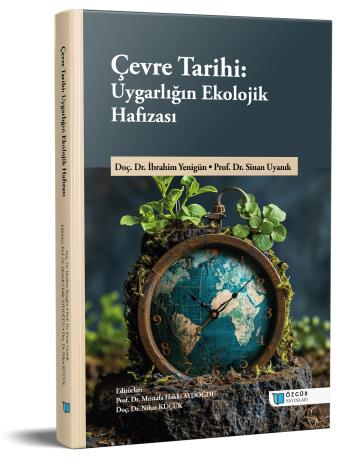
Environmental History: The Ecological Memory of Civilization
Synopsis
The book “Environmental History: The Ecological Memory of Civilization” offers a comprehensive interdisciplinary study of the historical relationship between humanity and nature. It traces the origins of environmental science, the emergence of ecological awareness, and the cultural, religious, and institutional foundations of environmental thought. By examining major environmental disasters, the rise of ecology as a discipline, and the historical development of environmental history, the work situates ecological consciousness within a broad civilizational framework.
The volume explores ancient and modern practices of water management, environmental law, and infrastructure, highlighting examples from Anatolian and Mesopotamian civilizations as well as the Ottoman Empire’s institutional and cultural approaches to environmental stewardship. Religious traditions—including Buddhism, Hinduism, Judaism, Christianity, and Islam—are analyzed in terms of their ecological perspectives and contributions to sustainable living.
Further sections address the historical evolution of environmental governance in Turkey, the role of the European Union and international cooperation, and the significance of environmental education in shaping sustainable futures. The book emphasizes the synergy between environmental history, education, media, and public perception, underscoring the power of ecological memory to inform contemporary challenges and inspire future leadership.
Ultimately, this study positions environmental history not merely as an academic field but as a foundational reference for modern environmental policies and educational practices, offering historical depth to current debates on sustainability and ecological responsibility.
How to cite this book
License

This work is licensed under a Creative Commons Attribution-NonCommercial 4.0 International License.
Published
ISBN
DOI
Statistics
Categories
Copyright (c) 2025 Sinan Uyanık- İbrahim Yenigün; Mustafa Hakkı Aydoğdu- Nihat Küçük