
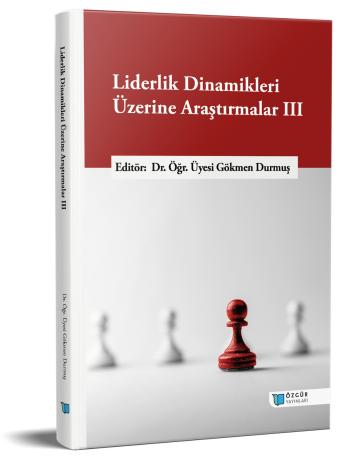
Political Leadership
Chapter from the book:
Durmuş,
G.
(ed.)
2025.
Research on Leadership Dynamics III.
Synopsis
This study demonstrates that the concept of political leadership has been continuously redefined throughout history through various theoretical approaches. A brief literature review, ranging from ancient understandings of leadership to leadership analyses developed within modern and postmodern political science, reveals that the phenomenon of leadership has evolved according to different contexts in each era. Indeed, this theoretical legacy brings with it new debates today, centered on populism and digitalization. While the power of populist leaders to mobilize masses shows continuity with charisma theory, it has gained a different dimension with "digital charisma" constructed through social media. The echo chambers created by social media algorithms force ideological and sensitive leader types to develop more flexible strategies; this makes the processes of generating legitimacy, persuading, and building trust more central in leadership practice. As a result, contemporary political leadership is shaped by dynamics such as globalization, cultural diversity, digitalization, and ideological ambiguities. The rise of populism and the transformative effect of social media, while making leadership more visible and effective on the one hand, also move it to a fragile and controversial ground in terms of democratic processes on the other. This contradictory structure has made political leadership both indispensable and a constantly questioned phenomenon.
How to cite this book
License

This work is licensed under a Creative Commons Attribution-NonCommercial 4.0 International License.
Published
DOI
Categories
Copyright (c) 2025 Gökmen Durmuş; Safa Arslan- Funda Öztürk- Hüseyin Çiçek- Buket Sezer- Metin Işık- Berkan Güngör- Esra Çıkmaz- Nil Çiftçi- Nadide Çakıroğlu- Alper Gürer- Fatma Gökçe- Kazım Yasin Özbey