
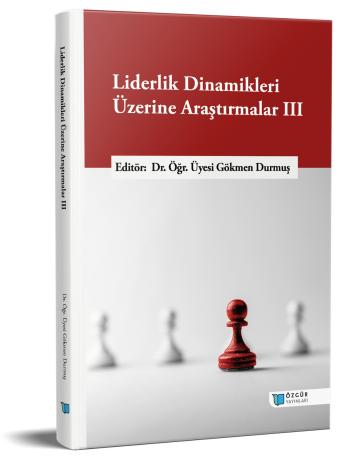
Creative and Innovative Leadership
Chapter from the book:
Durmuş,
G.
(ed.)
2025.
Research on Leadership Dynamics III.
Synopsis
Creativity and innovation are crucial drivers for personal development, economic growth, and societal progress. Especially today, with the rapid advancement of new technologies, the increasing pace of life and work, and the constant challenges posed by natural (or man-made) disasters, the importance of creativity and innovation is even more prominent. During this transition period, individuals or organizations that can unleash their creative potential and make the best use of their creative abilities will be one step ahead in the competition (Tang, 2017). In this respect, organizations that can effectively manage creative ideas and innovation systems can succeed in changing market conditions. Organizations lacking these may ultimately fail.
Heil, the founder of the Center for Innovative Leadership (CIL), stated that in today's competitive market environment and the rapidly changing workforce, companies can only survive and quickly reshape themselves to new situations through innovative leadership. Lyons (2011), similarly, stated that twenty-first-century companies have a great need for innovative leaders and human resources capable of effectively and efficiently implementing new ideas in every department of the company. Given the technological advancements, competitive environment, and struggles for economic power in today's world, it can be said that the need for creativity, the generation of new ideas, and the transformation of these ideas into usable products has increased. In response to these circumstances, organizations have begun to pay more attention to creative ideas in order to adapt to the current situation and ensure their sustainability. Since the emergence of creative ideas and the development of innovative products require leaders, the presence of creative or innovative leaders in organizations has become a prominent issue. The presence of such leaders in organizations and the innovations they provide enable organizations to quickly respond to customer demands and needs, enter new markets rapidly by creating new products and ideas, keep pace with technological developments, and gain the strength to compete against their rivals (Türk & Kara, 2018).
Although interest in developing and producing innovative products has increased today, much research continues to be conducted on how to best manage this innovative process and which type of leadership is most successful. Most of the research conducted so far emphasizes that leadership is one of the fundamental driving forces in increasing creativity and innovative output. Many studies have been conducted and different approaches proposed to understand how leaders shape the generation of new ideas and the development of new products, services, or processes based on these ideas. For example, some studies have examined the role of leaders in motivating the creative efforts of followers. These studies emphasize that leaders should support creative endeavors and focus on what leaders should do to create structures that enable the development of creative activities. Some research has suggested that, in order to create a functional perspective on how innovative results can easily emerge, it is necessary, even critical, to view creativity not as a single phenomenon, but as a set of interrelated processes. The view that developing creative ideas and creating innovations is the result of a series of dynamic and repetitive stages has been put forward and continues to be developed. The common point of all these studies is that leadership plays a significant role in shaping and creating successful innovations.
This section will discuss the type of leadership needed to produce successful innovative outcomes in organizations, how leaders should approach and manage in this regard, the characteristics and goals of creative and innovative leaders, and the fundamental differences between these leadership styles.
How to cite this book
License

This work is licensed under a Creative Commons Attribution-NonCommercial 4.0 International License.
Published
DOI
Categories
Copyright (c) 2025 Gökmen Durmuş; Safa Arslan- Funda Öztürk- Hüseyin Çiçek- Buket Sezer- Metin Işık- Berkan Güngör- Esra Çıkmaz- Nil Çiftçi- Nadide Çakıroğlu- Alper Gürer- Fatma Gökçe- Kazım Yasin Özbey