
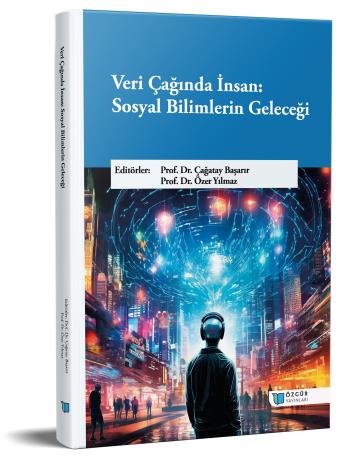
Economic Rationality and Data-Driven Decision Making: An Evaluation Towards Transformation in Human Behavior
Chapter from the book:
Başarır,
Ç.
&
Yılmaz,
Ö.
(eds.)
2025.
Human in the Data Age: The Future of Social Sciences.
Synopsis
The understanding of economic rationality has consistently been at the focus of schools of economic thought throughout the history of economics in shaping individual preferences. This study examines the historical, theoretical, and methodological transformation of the rational individual assumption in economic thought, presenting a multi-layered evolution stretching from classical economics to neoclassical economics, and from there to behavioral economics and data-driven decision-making approaches.
While in classical economics, the rational individual is treated as a multidimensional actor shaped by moral sentiments and social norms, going beyond utility maximization; neoclassical economics mathematically simplifies this model, reducing it to the homo economicus concept—an agent who possesses perfect information, has consistent preferences, and engages in optimization. The differences between the classical thinkers' assessment of human behavior within environmental and social context and the neoclassical model's abstract approach that excludes psychology, ethics, and cognitive limitations are discussed in detail.
It is understood that Simon’s concept of bounded rationality and Kahneman–Tversky’s behavioral findings in the mid-20th century fundamentally shook the neoclassical understanding of rationality by revealing the determinant role of intuitive thinking, cognitive biases, and psychological limitations in the decisions of economic actors. Global digitalization, big data, and artificial intelligence technologies are observed to have created a transformation in economic decision-making processes. In this context, it is stated that the rational individual assumption must be re-evaluated within the framework of algorithmic decision systems, data-driven forecasting models, and the concept of computational rationality. Overall, the study demonstrates that the rationality assumption has historically evolved from a single-dimensional model into a multi-dimensional, context-sensitive, and increasingly technological structure, emphasizing that understanding rationality in the modern economy necessitates an interdisciplinary approach that integrates economic theory, psychology, and data science.
How to cite this book
License

This work is licensed under a Creative Commons Attribution-NonCommercial 4.0 International License.
Published
DOI
Categories
Copyright (c) 2025 Çağatay Başarır- Özer Yılmaz; Nur Kuban Torun- Merve Önalan- Ömer Faruk Seymen- Volkan Akgül- Müjde Aksoy- Özer Yılmaz- Burçin Boz- Mehtap Türkan- Özgür Yılmaz- İlknur Tanrıverdi- Altuğ Günar- Çağatay Başarır- Cemalettin Hatipoğlu- Onur Özaydın