
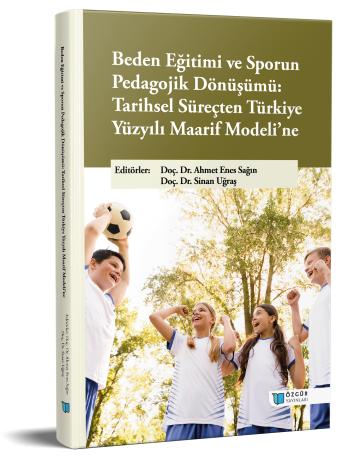
Values, Motivation, and Instructional Approaches: The New Paradigm of Physical Education and Sport Courses
Chapter from the book:
Sağın,
A.
E.
&
Uğraş,
S.
(eds.)
2025.
The Pedagogical Transformation of Physical Education and Sports: From the Historical Process to the Turkey Century Education Model.
Synopsis
This section explores the new paradigm of Physical Education and Sport courses within the context of values, motivation, and instructional approaches. It attempts to demonstrate how the PES course, throughout the transition from the behaviorist approach to the constructivist approach in Turkey and up to the "Turkish Century Education Model", has evolved from merely being a domain for acquiring psychomotor skills to one that supports holistic development. Furthermore, the text outlines the impact of global declarations and approaches—which prioritize lifelong physical activity, health, well-being, ethical values, and socio-emotional development—issued by international organizations such as the OECD and UNESCO on Physical Education pedagogy. The theoretical framework incorporates the TYMM's "holistic individual" and "Virtue-Value-Action" approach, the autonomy, competence, and relatedness needs of Self-Determination Theory, and the task and performance orientations of Achievement Goal Theory, along with the 2x2 Goal Model. It is presented as a crucial necessity, aligned with both the TYMM's vision and the global understanding of Physical Education, for teachers to involve low-motivated or self-inefficient students by employing inclusive practices, differentiated activities, and student-centered assessment methods. Finally, the text attempts to explain the integration of motivation-based psychological approaches like SDT and AGT into PES courses and the alignment of teaching styles with the theoretical and pedagogical framework.
How to cite this book
License

This work is licensed under a Creative Commons Attribution-NonCommercial 4.0 International License.
Published
DOI
Categories
Copyright (c) 2025 Ahmet Enes Sağın- Sinan Uğraş; Mehmet Akarsu- Mehmet Akif Yücekaya- Yusuf Tekin- Hüseyin Nasip Özaltaş- Abdullah Bingölbalı- Aysel Kızılkaya- Murat Çelebi- Can Nakip- Rahmi Yıldız- Cevdet Cengiz- Fatih Ateş- Mehmet Çetin- Ekrem Levent İlhan- Emel Çetin