
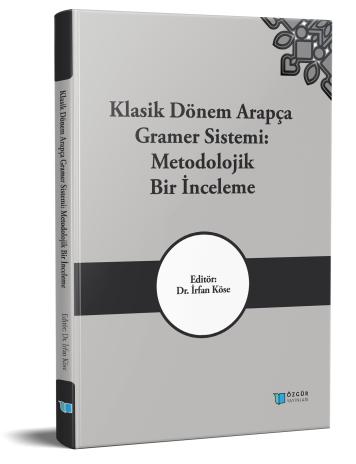
The Classical Period Arabic Grammar System: A Methodological Examination
Synopsis
Language is one of the most deeply rooted legacies in human history. One of the most effective tools for understanding language is undoubtedly the grammatical system. When considered specifically in relation to the Arabic language, this reality becomes even more pronounced. This is because Arabic, in addition to being a means of communication, is both the language of the Qurʾān and the repository of a vast intellectual tradition that carries the cumulative thought of Islamic civilization. Accordingly, the Arabic grammatical system embodies both linguistic and cultural depth through the historical context in which it was formed and the methodology it developed. This book emerged from the need to re-examine the classical-period methodology of Arabic grammar within its historical development, conceptual framework, and scholarly tradition. The approach of classical-period linguists to the study of language differs in many respects from contemporary linguistic paradigms. However, these differences do not diminish the methodological efficiency or the theoretical contributions of classical linguists. On the contrary, the systematic thinking they developed constitutes both a comparative perspective and a methodological laboratory for today’s researchers. The present volume, through contributions by different scholars, addresses the core concepts of classical grammatical thought, its founding figures, methodological divergences among schools, and the reflections of this intellectual legacy in contemporary studies. This compilation aims not only to provide a historical overview but also to offer new interpretive possibilities regarding how the theoretical efforts found in classical texts may be understood today.
During the preparation of the book, each author endeavored to illuminate the classical heritage of Arabic grammar from different perspectives, drawing upon their respective areas of expertise. This plurality of voices not only enhances the value of the work but also provides a significant opportunity for readers who seek to evaluate classical Arabic linguistic studies from a holistic perspective. As the editor, I aimed to bring this rich accumulation together within a scientific framework, to render areas open to discussion visible, and to lay the groundwork for future research. The book consists of a total of nine chapters.
The chapters are as follows:
Chapter 1: The first chapter, which serves as a general introduction, is entitled “The Formation Process and Historical Development of the Classical Period Arabic Grammatical Method.” In this chapter, the author aims to present the formation process and historical development of the Arabic grammatical system with scholarly objectivity.
Chapter 2: Entitled “The Epistemological and Paradigmatic Foundations of the Transmitted (Naqlī) Method of Linguistic Evidence (Istishhād) in the Classical Arabic Grammatical System,” this chapter focuses on analyzing the internal dynamics and the distinctive epistemology of classical Arabic grammatical thought on the basis of transmitted linguistic evidence. At the same time, it does not seek to intervene directly in modern debates concerning the preservation, revision, or complete abandonment of the classical Arabic grammatical system. Rather, it aims to contribute to a more sound and scholarly continuation of these debates by facilitating an accurate evaluation of the epistemological and methodological parameters of the classical period.
Chapter 3: Under the title “Methods of Rational Inference in Classical Period Arabic Grammatical Methodology,” the author examines the epistemological foundations and methodological functions of rational inference methods in classical Arabic grammar.
Chapter 4: In the study entitled “The Evidentiary Value of Ibn Mayyāda’s Poetry in Arabic Grammar,” the author aims to demonstrate in which grammatical issues Ibn Mayyāda’s poems were employed as linguistic evidence. By consulting certain early grammatical works and lexicons that have not been utilized in previous studies, the author presents the evidentiary material in a comprehensive manner.
Chapter 5: In this chapter, entitled “The Grammatical Conception of al-Khalīl b. Aḥmad,” the author identifies as the main point of departure an effort to move beyond the sterile debate surrounding the attribution of Kitābu’l-Jumal fī al-naḥw and to examine al-Khalīl b. Aḥmad’s grammatical conception through more reliable sources whose attribution is widely accepted. In this context, al-Kitāb and Kitābu’l-ʿAyn, the two foundational works in which al-Khalīl’s grammatical views can be most clearly traced, are taken as the primary focus.
Chapter 6: This chapter examines “Sībawayhi’s Influence on the Development of Arabic Grammar.”
Within this framework, the traces of the author’s methodology are followed in al-Kitāb, which preserved and transmitted earlier grammatical studies up to his time.
Chapter 7: This chapter consists of a study entitled “The Concept of Wit (Nukta) in ʿAmr b. Baḥr al-Jāḥiẓ’s Kitābu’l-Ḥayawān.” In this work, the author presents exemplary instances of al-Jāḥiẓ’s harmony between language and literary taste in Kitābu’l-Ḥayawān, one of the finest literary reflections of classical Arabic.
Chapter 8: Entitled “The Evidence of Samāʿ in al-Zajjājī’s Grammatical Methodology,” this chapter aims to examine the understanding of samāʿ in the grammatical methodology of Abū al-Qāsim ʿAbd al-Raḥmān b. Isḥāq al-Zajjājī, one of the leading linguists of the Abbasid period.
Chapter 9: Under the title “Ibn Jinnī’s Conception of Language and His Methodological Approach to Arabic Grammar,” this chapter examines Ibn Jinnī’s understanding of Arabic grammar from a methodological perspective. His views on the nature of language, its functioning, and its semantic system are analyzed under the headings of samāʿ, qiyās, taʿlīl, the relationship between syntax and inflection (naḥw–iʿrāb), derivation (ishtiqāq), and phonological theory. In this way, the chapter aims to elucidate Ibn Jinnī’s position in the history of linguistics, his methodological originality, and the influence of his thought extending toward modern linguistic theory.
I hope that this work will open new avenues for scholars engaged in the study of the Arabic language and grammar, postgraduate students, and all researchers interested in the classical traditions of Islamic scholarship.
I would like to express my sincere gratitude to the esteemed contributors whose efforts made this work possible, as well as to all scholars who generously offered their support during the preparation process.
I also hope that the present volume will contribute to a deeper understanding of the methodological depth of the classical period and serve as a catalyst for rethinking this tradition from a contemporary perspective.
How to cite this book
License

This work is licensed under a Creative Commons Attribution-NonCommercial 4.0 International License.
Published
ISBN
DOI
Statistics
Categories
Copyright (c) 2025 İrfan Köse