
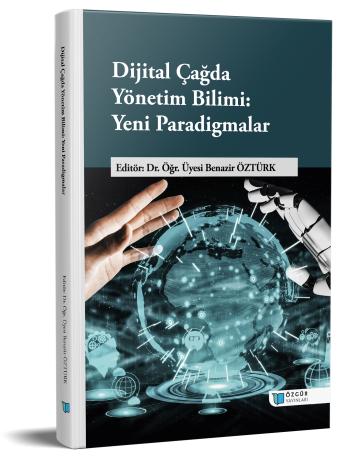
Digital Democracy and Governance: The Political Consequences of New Paradigms in Management Science
Chapter from the book:
Öztürk,
B.
(ed.)
2025.
Management Science in the Digital Age: New Paradigms.
Synopsis
Management science has been shaped throughout the 20th century within the framework of rational-bureaucratic organisational models. However, the changes and transformations experienced in technology and state administration in the 21st century have led to the development of the concepts of digital democracy and governance, which adapt to the dynamics of the information society. The first of these concepts, digital democracy, can be said to be the latest version of tele-digital democracy (electronic democracy) that sought to develop direct information flow and political participation among citizens through cable TV broadcasts in the 1980s. It can be said that this is the latest version of the virtual democracy concept that emerged in the 1990s with the development of the internet and communication services. The concept of governance was first introduced by the World Bank in 1989. It began to be developed in a report published by the same institution in 1992, which also stated that a sound understanding of governance was necessary to achieve an efficient and accountable structure in the public sector, a robust economic system, and a transparent policy framework. In light of these developments, the paradigm shifts and transformations in management science, particularly over the last forty years, have had a number of political consequences. As a result, the hierarchical, rigidly rule-based and bureaucratic structure of classical public administration has begun to give way to the performance-based, efficiency-oriented and market-like structure of new public management. This change and transformation, particularly since the 2000s, has brought with it digitalisation, network-based organisation and governance logic, and a data-driven decision-making structure. Thus, state administration, which had a single-centred and hierarchical structure, has begun to give way to a structure that embraces multi-actor, inclusive and horizontal decision-making processes. In this context, it can be said that the concepts of digital democracy and governance, which emerged as a result of the paradigm shift in management science, have a multi-layered structure that goes beyond a technical sense of modernisation; they reconfigure and reorganise state-society relations, channels and forms of political participation, the nature of representation, and the management style of public legitimacy.
How to cite this book
License

This work is licensed under a Creative Commons Attribution-NonCommercial 4.0 International License.
Published
DOI
Categories
Copyright (c) 2025 Benazir Öztürk; Adil Karabal- Ahmet Kumru- Ülviye Kılıç Karakelle- Fatih Koç- Özlem Yaşar Uğurlu- Özge Sevimli- Mücahit Çakır- Ali Göde