
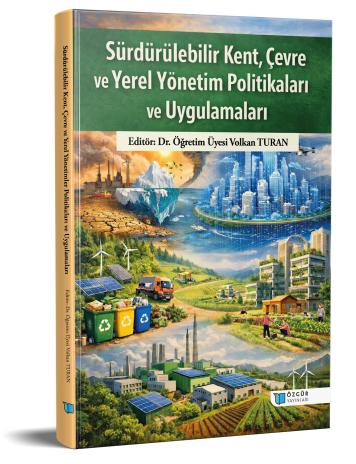
Cities at the Intersection of Digitalization and Sustainability: The Twin Transition Approach
Chapter from the book:
Turan,
V.
(ed.)
2025.
Sustainable City, Environment and Local Government Policies and Practices.
Synopsis
This chapter examines the twin transition approach, which advocates the integrated consideration of digitalization and green and sustainable transformation, in the context of sustainable cities and local governments. Today, cities have become spatial systems where multidimensional challenges such as climate change, environmental degradation, social inequalities, and economic vulnerabilities are most intensely experienced. These challenges position cities and local governments as critical actors in achieving sustainable development goals. Digital technologies offer significant opportunities in this process by strengthening data-driven decision-making, monitoring, and evaluation capacities; however, when digital transformation is pursued independently of sustainability objectives, it may also generate new risks. This chapter argues that digital transformation and sustainability should not be treated as separate policy domains, but rather as complementary and simultaneously managed processes. Within this framework, the twin transition approach conceptualizes digitalization as a strategic instrument that supports environmental, social, and economic sustainability goals. The chapter first discusses the conceptual foundations of the twin transition and then examines sustainable cities through their environmental, social, and economic dimensions. For each of these dimensions, the opportunities and limitations offered by digital technologies are critically assessed. The primary focus of the chapter is the policy and implementation dimensions of the twin transition from the perspective of local governments. In this regard, issues such as strategic and political ownership, institutional capacity, governance structures, university–industry–government collaboration, financing mechanisms, and potential risks are analyzed. In conclusion, the chapter demonstrates that the twin transition for sustainable cities should be understood not merely as a technological transformation, but as a holistic process that requires governance reform, institutional learning, and policy coherence.
How to cite this book
License

This work is licensed under a Creative Commons Attribution-NonCommercial 4.0 International License.
Published
DOI
Categories
Copyright (c) 2025 Volkan Turan; Bilge Villi- A. Selçuk Köylüoğlu- Hale Girşen- Şermin Atak Çobanoğlu- Murat Küçükşen- Ceyda Kükrer Mutlu- Orhan Şahin- Bülent Bayrak- Eray Aktepe- Gülseren Günaydın- Serhat Saatci