
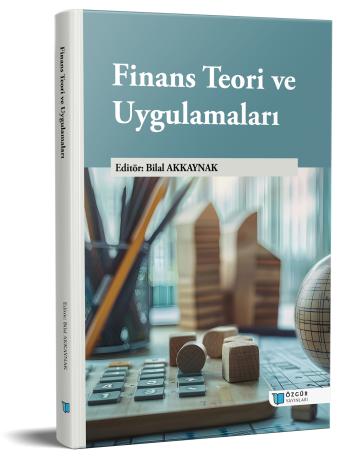
Volatility Behaviour in Borsa Istanbul: An Empirical Analysis Using ARCH-GARCH Models
Chapter from the book:
Akkaynak,
B.
(ed.)
2025.
Finance Theory and Practices.
Synopsis
This study examines the volatility structure of daily returns of the Borsa Istanbul 100 (BIST 100) index using models from the ARCH-GARCH family. The analysis is based on logarithmic daily returns derived from closing prices. Descriptive statistics indicate that the return series is non-normally distributed and exhibits fat-tailed characteristics. Stationarity is confirmed by Augmented Dickey-Fuller (ADF) and Phillips-Perron (PP) unit root tests. To specify the mean equation, alternative ARMA models are estimated and compared, with the MA (1) model selected according to the Akaike Information Criterion (AIC). Diagnostic tests reveal the presence of serial correlation and significant ARCH effects in the residuals, justifying the application of conditional heteroskedasticity models. Volatility is subsequently modelled using ARCH, GARCH, ARCH-M, EGARCH, and T-GARCH specifications. The results indicate that symmetric volatility is best captured by the ARCH model, whereas asymmetric volatility and leverage effects are more effectively explained by the EGARCH model. Overall, the findings suggest that volatility in the BIST 100 index exhibits asymmetric behaviour, highlighting the importance of selecting volatility models in line with the underlying characteristics of the return process.
How to cite this book
License

This work is licensed under a Creative Commons Attribution-NonCommercial 4.0 International License.
Published
DOI
Categories
Copyright (c) 2025 Bilal Akkaynak; Kübra Saka Ilgın- Ahmet Zelka- İsmail Fatih Ceyhan- Berk Yıldız- Ferhat Demirci- Aziz Kaldırım- Bilal Akkaynak- Gülhan Deniz- Muhsin Uslu- Murat Yıldırım- Hacer Şeyma Dilaver- Salim Sercan Sarı- Hilal Ok Ergün- Hümeyra Yıldız- Muhammed Yılmaz- İbrahim Yaşar Gök- İnci Merve Altan- Adem Ruhan Sönmez- Mehmet Ozan Akman- Hasan Aydın Okuyan- Devran Deniz- Elif Sinem Köse- Muhammed Hanifi Van- Yasin Cihan