
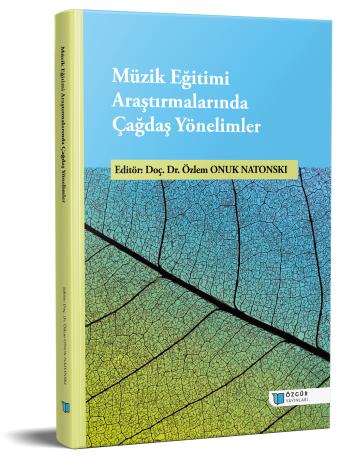
Holistic Music Education: An Approach Supporting Creativity and Personal Expression
Chapter from the book:
Onuk Natonski,
Ö.
(ed.)
2025.
Contemporary Trends in Music Education Research.
Synopsis
Today, music education has evolved beyond the mere development of technical skills to support the cognitive, emotional, and social growth of students. This study aims to highlight the significance of a holistic approach to music education and examine how it contributes to students’ creativity, musical understanding, and personal expression. The holistic approach emphasizes that music is not limited to performing or playing instruments but serves as a medium to enhance emotional expression, communication skills, and self-confidence.
The study explores the theoretical foundations of this approach, drawing on Froebel’s principles of holistic education, Gardner’s theory of multiple intelligences, and Dewey’s experiential learning perspective to demonstrate how music education can be enriched. Traditional skill-based music education is compared with holistic methods to evaluate their effects on student achievement, creative development, and musical comprehension. The study provides a comprehensive framework by introducing the key concepts of both approaches and examining their distinct impacts on students.
Given the limited number of studies in Turkish literature, this review integrates both national and international research to fill a critical gap. Ultimately, the study offers recommendations for more inclusive, student-centered, and creative practices in music education and emphasizes the long-term significance of holistic approaches for students’ personal development and their broader contributions to society.
How to cite this book
License

This work is licensed under a Creative Commons Attribution-NonCommercial 4.0 International License.
Published
DOI
Categories
Copyright (c) 2025 Özlem Onuk Natonski; Yunus Yapalı- Duygu Jafarova- Abdullah Kaya- Özlem Onuk Natonski