
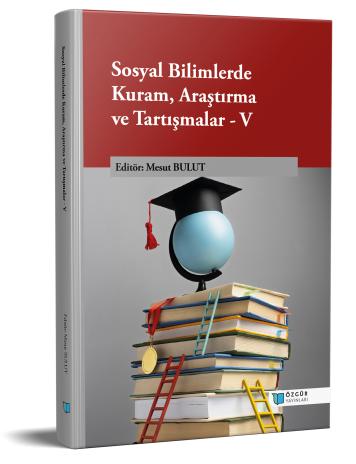
Theory, Research, and Debates in the Social Sciences - 5
Synopsis
Social sciences are defined as a group of disciplines vital to the individual's process of exploring themselves, their society, and the world around them. In this context, focusing on patterns of human behavior, social relationships, social structures, and the patterns of change and continuity of social structures over time, the social sciences address the complex relationships between the individual, society, and the environment from a systematic and scientific perspective. Social sciences are perceived not only as a body of thought that interprets society, but also as a fundamental body of thought that makes social life meaningful. The educational aspect of social sciences is more comprehensive than mere knowledge transfer. Therefore, the social sciences education process is a dynamic process aimed at acquiring high levels of competence in terms of critical thinking, social awareness, democratic consciousness, cultural awareness, and responsible citizenship. This process is highly beneficial in enabling individuals to develop their abilities to analyze social events and make judgments based on different ways of thinking for the good of humanity. In this respect, social sciences education has emerged as one of the most important disciplines for both individual and societal development.
The title of this book, “Theory, Research, and Debates in the Social Sciences,” aims to bring together current theoretical and practice-based academic thought and debates within the context of social science education. The chapters in this book address the multifaceted concepts of social science education from the perspectives of educational research, scientific research methods, multidisciplinary approaches, critical thinking approaches, and theoretical foundations, aiming to provide a high-level and fundamental contribution to the subject based on qualitative changes. This research reveals that social science education is more closely related to educational processes based on social science concepts and more closely linked to higher-level critical thinking processes in the context of social transformation and change patterns and values-based transmission processes. By bringing together knowledge from many disciplines, from anthropology to educational sciences, social science education gains more holistic and in-depth structures from a multidisciplinary perspective. Therefore, each chapter in this book has an external perspective in terms of the fundamental thoughts of academics in these different fields.
This book has been compiled in accordance with the principles of scientific method and intellectual integrity. The aim of this study is to develop the theory of social sciences education, shed light on its practice, and contribute to the intellectual discourse in the field. It is expected that this work will serve as a reference tool for researchers and academics working in the field of social sciences education, especially graduate students. On this occasion, I would like to express my gratitude to all the authors and the editorial board/editorial team for their efforts and intellectual contributions in preparing this study. I would also like to extend my special thanks to Dr. Kürşad Özkaynar for his valuable contributions.
Chapters
How to cite this book
License

This work is licensed under a Creative Commons Attribution-NonCommercial 4.0 International License.
Published
ISBN
DOI
Statistics
Categories
Copyright (c) 2025 Mesut Bulut; Murat Gökmen- Seda Gökmen- İlknur Demirbağ- Nurdan Kılıç- Yasin Demirci- Ziya Ersoy- Fatih Pala- Seyhan Bayram- Mesut Bulut