
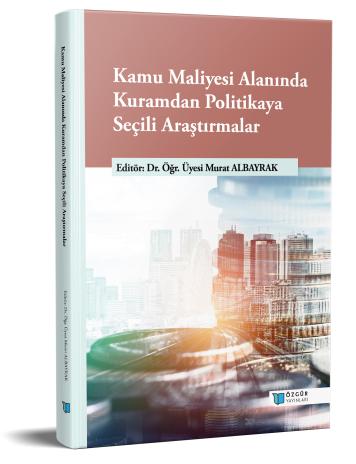
R&D Support in Türkiye: An Overall Evaluation within the Framework of Türkiye’s 2053 Vision
Chapter from the book:
Albayrak,
M.
(ed.)
2025.
Selected Studies from Theory to Policy in Public Finance.
Synopsis
The study examines the extent to which Türkiye’s research and development (R&D) support policies are aligned with the Türkiye 2053 vision within a conceptual and comparative framework. Building contemporary growth theories and the national innovation system approach, it analyses the interrelationships among science, technology, innovation and R&D, and explains why R&D policy constitutes a strategic area of public intervention for sustaining long-term development and international competitiveness. Within this framework, the 2053 vision’s goals of human capital-driven development, technology-intensive production, high-technology exports and a dynamic innovation ecosystem serve as the main analytical benchmarks. Methodologically, the study employs qualitative document analysis of Türkiye’s R&D legislation and institutional support architecture. It maps and classifies major policy instruments, including TÜBİTAK and KOSGEB programs, technoparks, Laws No. 4691 and 5746, and the new investment incentive system. Using data from the OECD, World Bank and World Intellectual Property (WIPO), the study compares indicators such as total and business R&D expenditure, R&D personnel, public support, patenting activity, high-technology exports and the Global Innovation Index for Türkiye, selected peer economies and benchmark country South Korea. The findings indicate that, despite significant increases in R&D spending and human resources, substantial gaps persist, particularly in business R&D, SME participation, innovation outputs and the diffusion of R&D beyond the defense sector. The study concludes that achieving the high value-added production structure and innovation capacity envisaged in the 2053 vision requires an upscaled, more private sector- and SME-oriented, regionally balanced and impact-evaluated R&D support system that would help move Türkiye closer to both its peer group and leading role-model economies.
How to cite this book
License

This work is licensed under a Creative Commons Attribution-NonCommercial 4.0 International License.
Published
DOI
Categories
Copyright (c) 2025 Murat Albayrak; Cemil Altun- Osman Pehlivan- Abdülhamid Özgün Birkalan- Recep Tekeli- Muhammet Aktuğ- Hüseyin Ünal- Erkan Kılıçer- İmren Peker Kılıçer- Esra Hanbay Kahriman