
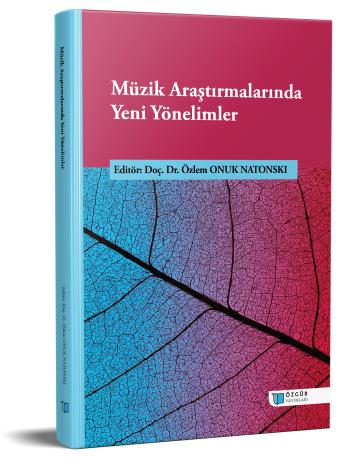
Modal Expression in the Five-String Double Bass: The Reflections of Renaud Garcia-Fons Techniques on Turkish Music Performance
Chapter from the book:
Onuk Natonski,
Ö.
(ed.)
2025.
New Trends in Music Research.
Synopsis
This research addresses the technical and timbral limitations faced by the traditional four-string double bass in articulating the melodic "seyir" (course) and high register "tiz durak" (high tonic) regions inherent in Turkish makam music. The primary aim of this study is to analyze the new performance possibilities offered by the five-string double bass (with a "high C" string), examining them through the innovative techniques developed by Renaud Garcia-Fons, who is widely regarded as the instrument's global pioneer. The study deciphers specific left-hand (e.g., pivot technique, artificial harmonics, fluid shifting) and right-hand (e.g., multi-finger pizzicato, percussive bowing) techniques that Garcia-Fons employs in Mediterranean, Flamenco, and modal jazz music. The potential of these techniques to be applied to the intonation of microtonal (koma) intervals in Turkish music, the execution of traditional ornamentations (trills, mordents), and especially their capacity to add a rhythmic and harmonic layer to the "taksim" (improvisation) form is discussed. In conclusion, this article posits that the aesthetic and technical framework established by Garcia-Fons provides a crucial model for the double bass to transcend its traditional "accompaniment" role in Turkish music and transform into a virtuosic "solo expressive" tool.
How to cite this book
License

This work is licensed under a Creative Commons Attribution-NonCommercial 4.0 International License.
Published
DOI
Categories
Copyright (c) 2025 Özlem Onuk Natonski; Fatih Tüysüz- Derya Kaçmaz- Duygu Ulusoy Yılmaz- Gamze Köprülü Yazıcı- Aziz Destegül- Hasan Mert