
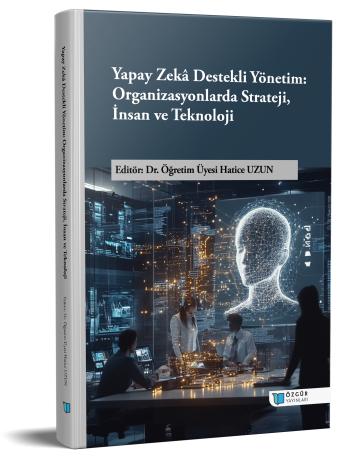
Artificial Intelligence in Organizational Behavior
Chapter from the book:
Uzun,
H.
(ed.)
2025.
AI-Enabled Management: Strategy, People, and Technology in Organizations .
Synopsis
Recently, the scientific world has highlighted the emotional dimension of human intelligence, attributing artificial intelligence to machines and creating a new debate, as with every concept it produces. It's possible to say that the technological leap now called the artificial intelligence revolution began approximately a century ago with the invention of ENIAC, the ancestor of the computer. Today, there is almost no area of human life untouched by computer technology. The use of artificial intelligence applications in organizations is becoming increasingly widespread, and its impact on employees is becoming more and more pronounced. Consequently, measuring the use of artificial intelligence in terms of variables related to the discipline of organizational behavior has come to the forefront. Research shows that the use of artificial intelligence has positive effects on phenomena such as job satisfaction, organizational commitment, innovative work behavior, and creativity. Furthermore, research has shown that using artificial intelligence tools increases productivity, strength, motivation, and problem-solving skills. Researchers emphasize that artificial intelligence can have negative effects on employees as well as positive ones. Artificial intelligence applications can lead to negative emotions such as anxiety, fear, anger, disappointment, and insecurity. Increasing unemployment and encouraging laziness are also among the negative effects of artificial intelligence. In addition, the research results contain some inconsistencies. For example, it has been noted that artificial intelligence applications have both increasing and decreasing effects on motivation, conflict, and stress. However, negative effects are not widespread. It is thought that factors such as the industry in which the experimental research was conducted, the method of production, and environmental factors play a role in this. Furthermore, a certain level of conflict and stress is a positive situation for organizations. Conducting meta-analyses on the subject will be beneficial in revealing the dominant effects of artificial intelligence on organizational behavior. On the other hand, the framework of artificial intelligence regarding issues such as control, privacy, and ethics still remains unclear. In the near future, it is expected that the discussion will focus more on the role of artificial intelligence in influencing humans as a tool of power and policy, rather than on whether it will replace humans.
Keywords:
How to cite this book
License

This work is licensed under a Creative Commons Attribution-NonCommercial 4.0 International License.
Published
DOI
Categories
Copyright (c) 2025 Hatice Uzun; Hatice Uzun- Ahmet Ferda Çakmak- Ömer Dulkadir- Halime Göktaş Kulualp- Gökşen Gedik- Zeynep Dilara Tınaz