
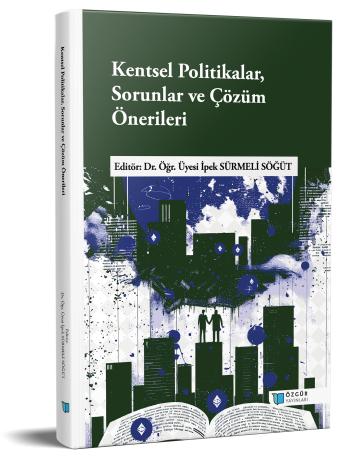
Urban Policies, Problems and Solutions
Synopsis
Dear Readers,
Cities have historically been the locations of civilization, culture, and society, and recently they continue to be the hubs of development through Globalization, migration, neoliberalism, and political action for a democratic society. Cities provide the opportunity for different problems to be worked on collectively and as urban researchers (interdisciplinary) we can develop solutions to the structural issues of cities and how they impact communities through the implementation of policies in a collaborative manner.
The chapter "Urbanization, Migration and Social Cohesion: Theoretical Perspectives," authored by Hakan Candan and Melike Akpinar, presents an insight into the urbanisation and migration processes from a theoretical standpoint. The authors consider urbanisation and migration to be complex social processes rather than merely demographic or economic. This chapter discusses how urban policies based on neoliberal economic principles create inequities in urban areas through increasing wealth concentration and a proliferation of gated communities, how migrants become concentrated in areas that are subject to ghettoization and therefore excluded from social service delivery, and how social cohesion is a result of the structure of inequality (i.e., the product of structural injustices rather than simply cultural adaptation). The authors propose that to address the issue of social cohesion requires the development of inclusive urban policies, multi-level governance systems and a rights-based approach to urban migrant issues.
Chapter 2 is written by Murat KÜÇÜKŞEN and is entitled “Participatory Urban Governance – City Councils.” The chapter looks at how important democratic participation is for dealing with systemic problems that cities have. The study analyses the different aspects of the legal basis, administrative and financial structure, role, and primary concerns associated with city councils within Turkey and includes numerous constraints that would inhibit city councils from functioning as a multi-stakeholder platform under the overall governance structure. The findings indicate that city councils experience many obstacles in being able to operate effectively as a multi-stakeholder platform such as decision-making being limited to advice only, lack of independence with respect to financial and administrative decision-making and lack of visibility within the community. Strengthening city councils, which are some of the most concrete examples of Participatory Democracy on a Local Level, will enhance the legitimacy and enable effective Urban Governance.
Both chapters serve as complementary fundamental pillars related to two issues: structural inequalities and social vulnerabilities associated with urbanization and Migration and with respect to the democratic participation, transparency And multi-Stakeholder Governance Mechanisms for finding solutions. The research of CANDAN And AKPINAR provides insight into the Global and Structural dimensions of the problem, while KÜÇÜKŞEN's research offers an illustration of how the solution can be implemented in practice at the Local and Institutional levels. In both cases, we are reminded that Cities are not simply Physical Spaces; cities provide opportunities For a sense of belonging and an and Arena for Rights to be won through every form of democratic struggle; from political processes to civil resistance.
Cities aren't just constructed environments containing stone, earth, concrete and metal; they're environments where people gather, create community, remember their past, and envision their future. The third chapter of İpek SÜRMELİ SÖĞÜT's book, "Major Earthquakes and Housing Policy from the Republic Period to Today," looks into the evolution of housing policy over time due to natural disasters, and how this relationship has been formative throughout the past century, specifically from the 1924 Erzurum to the 2023 Kahramanmaraş Earthquakes. The author illustrates that the way public policy in Turkey has developed as a response to potential devastation of home or property due to disaster is mostly driven by reactions ('reactive'), as opposed to responding in a proactive way. Many times such laws were created to address a temporary problem for the government, but over time have been transformed into means of creating wealth (via "rent-seeking") as opposed to benefiting the public at large. The writer identifies three major issue areas for study; the continued existence of temporary housing (due to an inability to create permanent housing), the exclusion of vulnerable populations (i.e., tenants) from the response process, and the challenges associated with coordination between the federal and local governments. The writer uses the phrase "taking precautions" not only to describe actions that strengthen structures, or to define the actions and procedures the state takes to protect its citizens through safe building codes, but also to discuss the need to have a comprehensive set of housing policies that are based on: social justice and equality, the right to safe and affordable housing for all (irrespective of income), and that all stakeholders are included in the policy-making process.
The goal of this book, Urban Policies and Issues and Their Proposed Solutions, is to serve as a resource for local officials, political leaders and citizens who want to understand and change their cities. The authors and editors believe that the findings and commentaries collected here provide a foundation for building more equitable, fairer, inclusive and liveable cities.
I wish to thank the many authors and the publishing team for their collaborative efforts in bringing the book to fruition.
Sincerely,
Assist. Prof. Dr. İpek SÜRMELİ SÖĞÜT
Chapters
Keywords:
How to cite this book
License

This work is licensed under a Creative Commons Attribution-NonCommercial 4.0 International License.
Published
ISBN
DOI
Statistics
Categories
Copyright (c) 2025 İpek Sürmeli Söğüt; Hakan Candan- Melike Akpınar- Murat Küçükşen- İpek Sürmeli Söğüt