
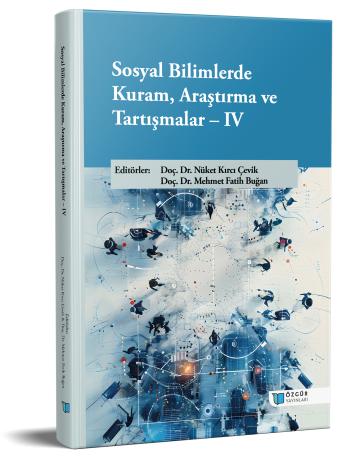
Minimal State Theory: Can the State Be Justified?
Chapter from the book:
Kırcı Çevik,
N.
&
Buğan,
M.
F.
(eds.)
2025.
Theory, Research and Debates in Social Sciences - 4.
Synopsis
Robert Nozick, one of the prominent figures of contemporary liberal political philosophy, seeks to reconstruct the moral legitimacy of the state through a rights-based framework in his influential work Anarchy, State, and Utopia. According to Nozick, a morally legitimate state can emerge through a “process that does not violate the rights of any individual” and by ensuring the protection of natural rights. The main question of this study is to what extent Nozick’s claim—that the only morally legitimate form of state is the minimal state—succeeds in refuting the objections raised by individualist anarchism.
This study critically examines the debate on state legitimacy within libertarian and anarchist thought by focusing on Nozick’s explanatory concepts such as the state of nature, the invisible hand process, and the principle of compensation. Nozick’s attempt to explain the emergence of the state from a Lockean state of nature without any violation of individual rights constitutes an original response to anarchist arguments. However, critiques pointing to conceptual tensions—particularly the issues of compensation and free-riding—challenge the consistency of his moral justification. Consequently, this study aims to provide a comparative evaluation of Nozick’s minimal state theory, highlighting both its theoretical significance within libertarian thought and its moral limitations in establishing a fully legitimate state.
How to cite this book
License

This work is licensed under a Creative Commons Attribution-NonCommercial 4.0 International License.
Published
DOI
Categories
Copyright (c) 2025 Nüket Kırcı Çevik- Mehmet Fatih Buğan; Saim Alper Ayas- Orhan Ecemiş- Orhan Orçun Bıtrak- Pınar Çelik Çaylak- Nisa Ekşili- Gamze Kara Çetinkaya- Gaye Gökalp Yılmaz- Melisa Başkuş- Ali Aslan Şendoğdu- Nezahat Koçyiğit- Şemseddin Gündüz- Esra Pekmez- Eral Ünsaç- Şükrü Mert Karcı- Ceyda Kükrer Mutlu