
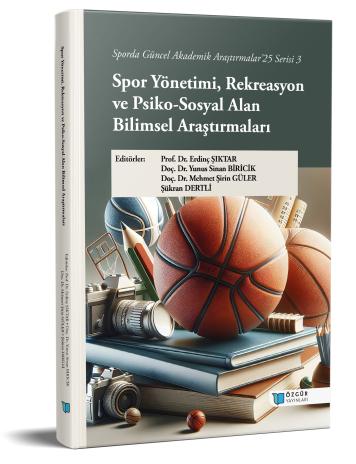
Sports-Based Community Development in Local Governments
Chapter from the book:
Şıktar,
E.
&
Biricik,
Y.
S.
&
Güler,
M.
Ş.
&
Dertli,
Ş.
(eds.)
2025.
Scientific Research in Sports Management, Recreation and Psycho-Social Field.
Synopsis
This section analyzes the ability of local governments to facilitate social development via sports from both theoretical and practical viewpoints. Contemporary sports offer not just physical engagement but also serve multifaceted social purposes, such as fostering social connections, promoting social inclusion, enhancing health equity, democratizing everyday life, and facilitating communal utilization of public spaces. The Sport for Development and Peace (SDP) concept asserts that the capacity of sports to effect social change is not intrinsic; it is realized through inclusive, accessible, and lifecycle-oriented program designs. In this context, local governments serve not just as producers of facilities but also as community facilitators, agents of social policy, and entities that prioritize the public dimension of spatial planning.
Instances from Turkey, including Istanbul, Izmir, Ankara, and Eskişehir illustrate that secure and accessible spatial design for women's engagement in sports, a universal design methodology for individuals with disabilities, peer-oriented integration initiatives for youth and immigrant populations, and the establishment of neighborhood-level sports ecosystems collectively augment social impact. Moreover, volunteer-driven sports communities enhance social capital and promote local civic consciousness. Consequently, sports hold strategic significance as a transformative policy instrument for local governments in fostering health, social equity, community belonging, solidarity, and enhancing the quality of public life.
How to cite this book
License

This work is licensed under a Creative Commons Attribution-NonCommercial 4.0 International License.
Published
DOI
Categories
Copyright (c) 2025 Erdinç Şıktar- Yunus Sinan Biricik- Mehmet Şirin Güler- Şükran Dertli; Hatice Gezer- Gül Eda Burmaoğlu- Yunus Sinan Biricik- Emre Belli- Elif Ceylan- Muhammed Doğukan Tozoğlu- Eyüp Uğur- Sertaç Erciş- Arzu Gülbahçe- Sefer Karabağ- Ahmet Şirinkan- Vahdet Alaeddinoğlu- Yıldırım Gündoğdu- Ceren Solmaz Çakmak