
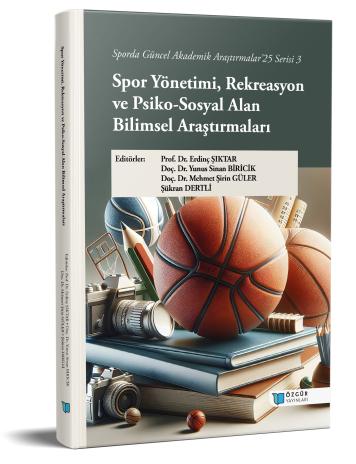
Social and Sporting Dynamics in Cross-Country Skiing and Biathlon: An Interdisciplinary Approach
Chapter from the book:
Şıktar,
E.
&
Biricik,
Y.
S.
&
Güler,
M.
Ş.
&
Dertli,
Ş.
(eds.)
2025.
Scientific Research in Sports Management, Recreation and Psycho-Social Field.
Synopsis
This study examines cross-country skiing and biathlon not only in terms of physical performance but also through their social, psychological, and cultural dynamics, adopting an interdisciplinary perspective. The aim is to reveal how these two winter sports are shaped at both individual and societal levels, highlighting athletes’ experiences and the structural characteristics of the disciplines. Qualitative research methods were employed, including in-depth interviews with athletes, coaches, and sport administrators actively engaged in these fields in Turkey. Thematic analysis revealed that cross-country skiing and biathlon are characterized by endurance, high aerobic capacity, intrinsic motivation, and strategic decision-making, as well as their close interaction with nature.
From a technical standpoint, VO₂max values were identified as a key determinant of performance in cross-country skiing, while in biathlon, the relationship between heart rate control and shooting accuracy proved to be critical. Furthermore, socio-cultural findings indicated that these sports are more prevalent in rural regions, with gender roles, economic accessibility, and institutional support directly influencing athlete development. Biathlon, due to its inclusion of rifle shooting, presents unique psychological preparation requirements and raises ethical debates distinct from other endurance sports.
In conclusion, cross-country skiing and biathlon can only be fully understood through their multi-layered dynamics, which extend beyond physical skills into social and cultural contexts. The study suggests that sport policies and educational programs should be restructured with an interdisciplinary perspective to foster sustainable development in these disciplines.
How to cite this book
License

This work is licensed under a Creative Commons Attribution-NonCommercial 4.0 International License.
Published
DOI
Categories
Copyright (c) 2025 Erdinç Şıktar- Yunus Sinan Biricik- Mehmet Şirin Güler- Şükran Dertli; Hatice Gezer- Gül Eda Burmaoğlu- Yunus Sinan Biricik- Emre Belli- Elif Ceylan- Muhammed Doğukan Tozoğlu- Eyüp Uğur- Sertaç Erciş- Arzu Gülbahçe- Sefer Karabağ- Ahmet Şirinkan- Vahdet Alaeddinoğlu- Yıldırım Gündoğdu- Ceren Solmaz Çakmak