
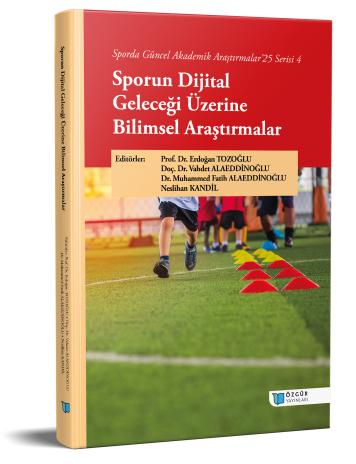
The Interdisciplinary Interaction of AI, VR, and AR Technologies in Elite Sports: An Examination Using Visual Mapping Techniques
Chapter from the book:
Tozoğlu,
E.
&
Alaeddinoğlu,
V.
&
Alaeddinoğlu,
M.
F.
&
Kandil,
N.
(eds.)
2025.
Scientific Research on the Digital Future of Sports.
Synopsis
This bibliometric study comprehensively examines the interdisciplinary interaction of artificial intelligence (AI), virtual reality (VR), and augmented reality (AR) technologies in elite sports during the period 1996–2026. The 193 documents analyzed and the contributions of 589 researchers indicate that the field is still developing and has largely progressed through multi-authored, team-based production. Findings from the three-field analysis and factorial analysis reveal that AI, VR, and AR technologies are not merely performance- and health-focused tools, but represent an interdisciplinary structure that integrates athlete experience, identity, social interaction, and ethical dimensions. Word clouds, co-occurrence networks, and trend analyses show that data-driven decision support systems, sensor-based tracking technologies, and machine learning and deep learning algorithms are becoming increasingly decisive in performance, analysis, and training processes in elite sports. The constant emphasis in the literature on issues such as ethics, justice, doping, and athlete rights confirms that technological innovations have not only technical but also social and normative dimensions. Thematic evolution and co-occurrence network analyses reveal the transformation of concepts over time and their continuous interaction, while factorial analyses demonstrate the multidimensional structure of the literature and its interdisciplinary connections through eight main clusters. The annual average citation curve shows that the field experienced a high citation impact in its early years, balanced but limited visibility in the mid-2000s, and an expanding literature structure in terms of both production and academic impact after 2016. These citation dynamics reveal that the interdisciplinary nature of AI, VR, and AR technologies in the context of elite sports is increasingly strengthening and being referenced more intensively by researchers. These findings make the study a unique work that maps the interdisciplinary interaction of AI, VR, and AR research in elite sports. Future research should emphasize deepening the socio-cultural and ethical dimensions, focusing on different sports disciplines and populations, tracking technology-driven innovations, developing mixed methods, and conducting long-term studies. Furthermore, prioritizing data privacy and algorithmic transparency as key research areas could contribute to the sustainable and ethical advancement of the interdisciplinary interaction of AI, VR, and AR technologies in elite sports.
How to cite this book
License

This work is licensed under a Creative Commons Attribution-NonCommercial 4.0 International License.
Published
DOI
Categories
Copyright (c) 2025 Erdoğan Tozoğlu- Vahdet Alaeddinoğlu- Muhammed Fatih Alaeddinoğlu- Neslihan Kandil; Murat Turan- Buğra Çağatay Savaş- Muhammet Mavibaş- Muhammet Emin Dertli- Seda Erden Dertli- Tolga Turay- Şükran Dertli- Onur Erdem Korkmaz